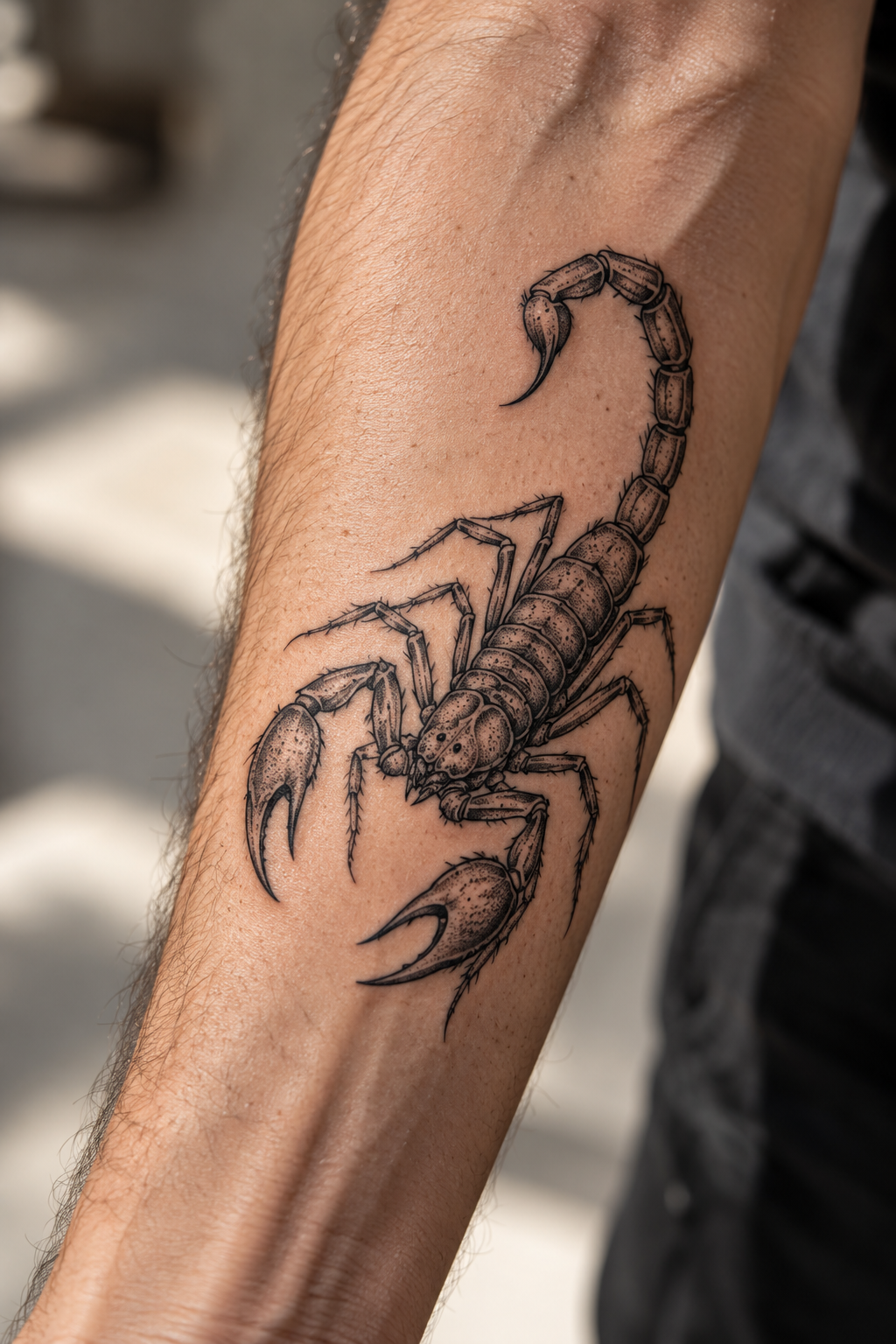
Scorpion Tattoo Ideas That Balance Power With Good Design
Scorpions have an unmistakable silhouette. The raised tail, curved body, claws, and segmented legs can make even a very small tattoo feel intense. That makes the scorpion a natural choice when you want a design associated with protection, resilience, danger, independence, or personal strength.
The challenge is making that intensity look intentional. A scorpion tattoo can become visually crowded when every leg, body segment, claw, and tail detail is squeezed into too little space. On the other hand, simplifying the design too aggressively can make the animal difficult to recognize. The best scorpion tattoo ideas find a balance between fierce symbolism and clean composition.
There is plenty of room to personalize the concept. A fine-line scorpion can feel elegant and controlled, while heavier blackwork creates a tougher appearance. Botanical details soften the silhouette. Celestial elements can connect the design with Scorpio symbolism, and geometric shapes can make a traditional animal motif feel more contemporary.
Before choosing your final design, think about what you want the scorpion to represent and where its naturally curved shape will work best on your body. These 20 ideas offer different approaches without losing the animal’s distinctive character.

What Does a Scorpion Tattoo Mean?
Scorpion tattoo meaning can vary considerably from one person to another. The animal is frequently associated with defense because a scorpion uses its sting as protection. That makes it an appealing symbol for someone who wants a tattoo representing boundaries, self-preservation, or the ability to protect what matters.
Scorpions can also represent strength and resilience. They survive in harsh environments, giving the motif a natural connection to endurance and adaptability. For some people, the tattoo marks a difficult period they survived. For others, it simply represents confidence and personal power.
There is also an obvious astrological interpretation. Scorpio is one of the zodiac signs, so a scorpion can become a more visual alternative to lettering or a traditional zodiac glyph. You can keep the connection subtle or combine the animal with stars, a constellation, crescent moon, or Scorpio symbol.
- Protection: defending yourself and maintaining strong boundaries.
- Power: quiet strength, confidence, and personal authority.
- Resilience: surviving difficult circumstances and adapting.
- Transformation: moving beyond an old version of yourself.
- Independence: relying on your own instincts and judgment.
- Scorpio identity: representing the zodiac sign through imagery rather than words.
You do not need to use every traditional meaning. A symbolic tattoo is usually stronger when you decide what the image means specifically to you and then build the design around that interpretation.
20 Scorpion Tattoo Ideas for Protection and Power
1. Fine-Line Scorpion
A fine-line scorpion is one of the easiest ways to make this naturally aggressive subject feel refined. Use a clean outline, restrained segmentation, and carefully spaced legs rather than packing the design with tiny details. The result can work beautifully on the forearm, upper arm, calf, or ankle.
2. Small Scorpion Silhouette
If you prefer minimal tattoos, consider a compact black silhouette. The recognizable claws and curled tail can communicate the subject without requiring detailed anatomy. A silhouette is particularly effective when you want a small wrist, ankle, or upper-arm tattoo that still has a strong visual identity.
3. Scorpion With Raised Tail
The raised tail is the most defensive-looking version of the motif. Positioning the tail above the body creates tension and movement while reinforcing themes of protection and readiness. This composition works well vertically on the forearm, calf, shin, or back of the upper arm.
4. Blackwork Scorpion
For something more commanding, use solid black areas and heavier linework. Blackwork can emphasize the claws, body armor, and tail while reducing the need for excessive internal detail. Give the darker sections enough negative space so the scorpion remains readable rather than turning into one dense black shape.
5. Tiny Wrist Scorpion
A small wrist design can feel surprisingly bold because it remains visible despite its size. Keep the anatomy simplified and avoid packing numerous extremely thin lines into the legs. A slightly thicker outline or simplified silhouette may remain visually clearer than an intricate miniature design.
6. Scorpion and Crescent Moon
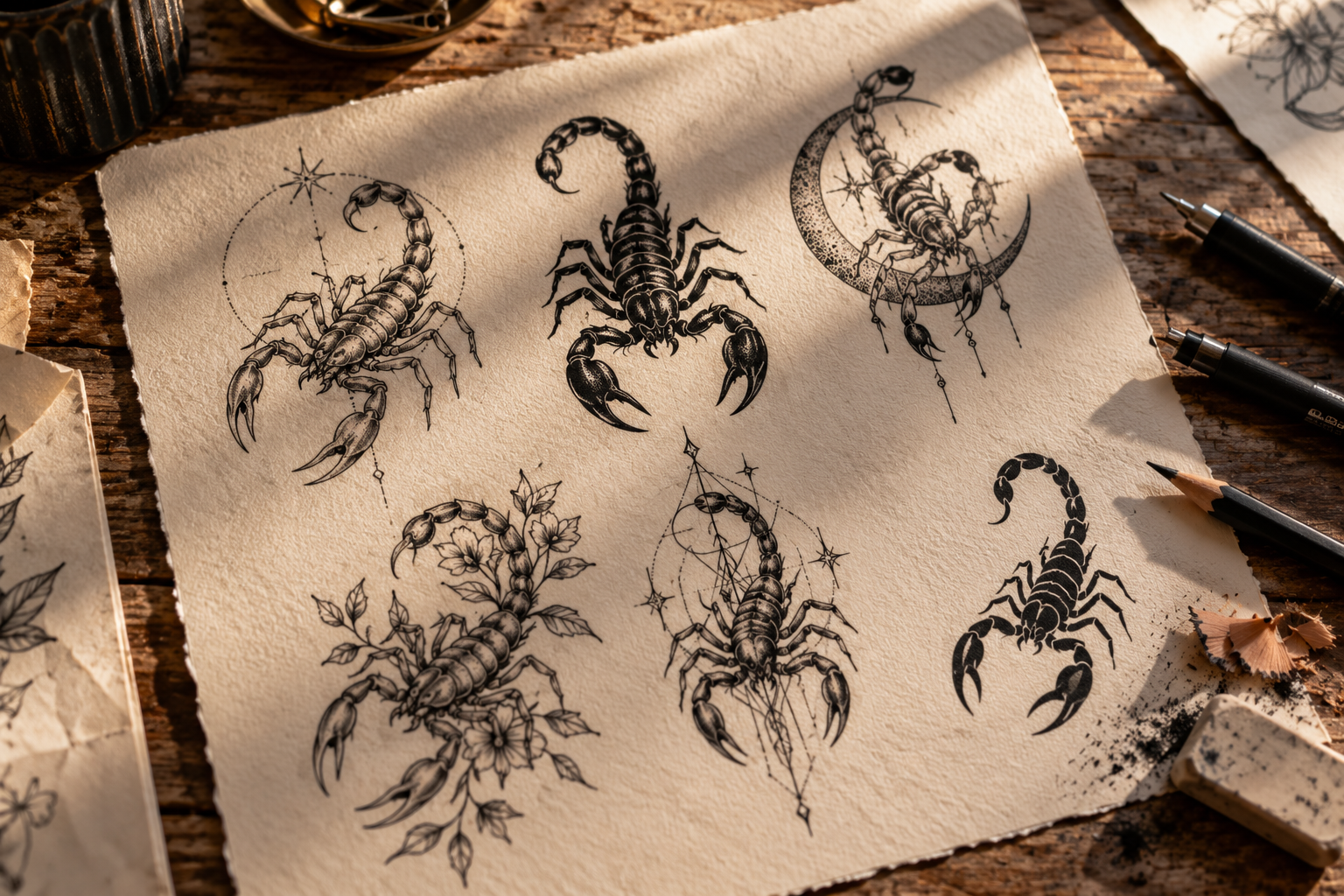
Combining a scorpion with a slim crescent creates a darker celestial aesthetic without becoming overly elaborate. The scorpion can sit inside the crescent, curve around its edge, or appear beneath it. This is a strong option for someone interested in subtle spooky imagery or celestial zodiac tattoo ideas.
7. Scorpio Constellation Scorpion
For a direct astrological connection, combine a fine-line scorpion with a restrained scattering of stars inspired by the Scorpio constellation. Keep the stars secondary so they frame the animal instead of competing with it. This approach works especially well on the forearm, shoulder blade, ribs, or upper arm.
8. Scorpion With Wildflowers
Wildflowers provide an interesting contrast to the scorpion’s defensive appearance. A few stems can curve alongside the tail or grow around the claws, creating a balance between softness and strength. This combination is particularly effective in fine-line or illustrative styles.
9. Scorpion With a Rose
A rose-and-scorpion composition has a stronger traditional tattoo influence. Instead of simply placing the two motifs side by side, let the scorpion interact with the flower. It might crawl across the stem, curve around the bloom, or sit beneath the petals. The contrasting shapes make the composition more dynamic.
10. Ornamental Scorpion
Ornamental details can transform the scorpion into a decorative centerpiece. Fine dots, symmetrical flourishes, tiny diamonds, and restrained line patterns can extend from the animal without disguising its silhouette. This approach suits the sternum, spine, upper back, thigh, and other placements where symmetry has enough room to breathe.
11. Geometric Scorpion
A geometric interpretation reduces the animal into deliberate angles and structured shapes. Straight lines can contrast with the naturally curved tail, creating a modern look. Keep enough anatomical cues around the claws and tail so the design still reads immediately as a scorpion.
12. Scorpion in a Circle
Framing the animal inside a circle gives the tattoo a contained, emblem-like appearance. The tail can follow the circular border, helping the design feel integrated rather than simply placed inside a shape. This is useful for the upper arm, shoulder blade, thigh, or calf.
13. Scorpion and Dagger
If you want something unmistakably fierce, combine the scorpion with a dagger. A vertical dagger provides a strong central axis while the claws and tail create movement around it. This design needs enough room to prevent the details from competing, making the forearm, calf, or thigh practical placement options.

14. Scorpion With Flames
Small stylized flames can push the imagery toward a more intense interpretation of power. Rather than filling every empty area, use the flames as supporting shapes around the animal. Black linework with selective solid areas can keep the composition bold without making it chaotic.
15. Minimal Single-Line Scorpion
A continuous-line interpretation strips the scorpion down to its essential shape. This is less anatomically realistic and more graphic, making it a good choice for someone who likes minimalist tattoos. The success of this concept depends heavily on the artist’s ability to simplify the animal while preserving its recognizable posture.
16. Realistic Scorpion
A realistic scorpion gives the artist room to show body segmentation, texture, shadows, pincers, and the distinctive stinger. Because those details require space, avoid forcing realistic artwork into a tiny placement. The thigh, calf, upper arm, shoulder, or larger forearm area gives the design more room to remain readable.
17. Scorpion With Protective Eye Symbol
If protection is the central meaning behind your tattoo, an eye motif can strengthen that concept. The eye can sit above the scorpion or appear within a geometric frame behind it. Keeping the secondary symbol simple prevents the design from feeling overloaded.
18. Scorpion and Sun
A sun adds another layer of visual contrast. The scorpion’s dark, defensive silhouette can sit against clean radiating lines, producing a design that feels symbolic without requiring text. A circular sun also provides structure around the irregular outline of the legs and claws.
19. Scorpion Spine Tattoo
The scorpion’s elongated body naturally lends itself to vertical placement. A carefully designed piece can follow the center line of the upper or lower back, with the tail continuing the movement. This placement can accommodate a larger design while preserving symmetry.
20. Scorpion With Personal Symbolism
The most meaningful option may be one that cannot be copied directly from a flash sheet. Start with the scorpion and incorporate one small element connected to your own story: a significant flower, a tiny star arrangement, an important number, an abstract mark, or another restrained symbol. The addition should support the scorpion rather than overwhelm it.

Best Placements for a Scorpion Tattoo
Placement has an unusually large effect on a scorpion tattoo design because the animal has multiple thin appendages and a curved tail. Instead of treating placement as an afterthought, choose an area that complements the orientation of your specific drawing.
The forearm is versatile because it provides enough length for a scorpion with an extended or raised tail. A vertical scorpion can follow the arm naturally, while a slightly diagonal design can create additional movement.
The calf and shin provide similar advantages. They work particularly well for larger blackwork, illustrative, or realistic pieces that need more breathing room around the legs.
The ankle is better suited to a simplified scorpion. A small design can sit just above the ankle bone or follow the side of the lower leg. If you want substantial anatomical detail, increasing the size generally gives the artist more room to separate the lines.
The upper arm and shoulder can accommodate wider compositions, including scorpions paired with flowers, celestial details, circles, or geometric framing. Larger placements also make it easier to preserve negative space between individual elements.
- Wrist: best for tiny silhouettes and simplified fine-line designs.
- Forearm: excellent for vertical scorpions and medium-detail pieces.
- Upper arm: useful for framed, botanical, or moderately large compositions.
- Ankle: works for small and restrained designs.
- Calf: provides space for bold blackwork and detailed scorpions.
- Thigh: ideal when you want larger illustrative or realistic artwork.
- Back: suitable for symmetrical or elongated statement pieces.
Fine-Line or Bold Scorpion Tattoo: Which Works Better?
Neither style is automatically better. The right choice depends on the size, placement, amount of detail, and overall appearance you want.
A fine-line scorpion tattoo can look elegant, contemporary, and less visually heavy. It is especially effective when the design uses a simplified body and intentionally spaced legs. Fine-line work also pairs naturally with flowers, stars, moons, and ornamental details.
Bold linework creates a different effect. Heavier outlines make the scorpion feel more graphic and aggressive. They can also help clearly separate the animal’s major anatomical features. Traditional, blackwork, and simplified illustrative designs benefit from this approach.
The mistake is assuming that every part of a small scorpion needs the same level of detail as a large reference drawing. Extremely tiny legs, pincers, body segments, and shading can create visual congestion. Ask your tattoo artist which details should be retained, enlarged, simplified, or removed for the scale you have chosen.
How to Keep a Scorpion Tattoo From Looking Too Busy
A scorpion already contains a lot of visual information. There are eight legs, two pincers, multiple body sections, and a segmented tail ending in a stinger. Adding flowers, stars, flames, lettering, geometric frames, and shading all at once can quickly weaken the design.
Start by deciding which element should dominate. In most cases, that should be the scorpion. Supporting details can then reinforce the mood or meaning without competing for attention.
- Choose one main symbol. Make the scorpion the visual anchor.
- Limit supporting imagery. One flower, moon, sun, or geometric frame may be enough.
- Preserve negative space. Leave visible separation between legs and nearby decorative elements.
- Match detail to scale. Larger designs can support more texture than tiny tattoos.
- Design for the placement. Let the tail and body follow the natural direction of the chosen area.
Clean composition often makes a tattoo look stronger, not simpler. A clearly defined silhouette can communicate power more effectively than a complicated design in which every available space has been filled.
The Thin-Line Mistake to Discuss With Your Tattoo Artist
Small scorpion tattoos often look impressive in highly enlarged reference images because you can see every tiny leg and segment. On actual skin, however, the physical scale is very different. Trying to reproduce numerous tightly packed lines in a miniature design may compromise clarity.
This does not mean you have to avoid fine-line work. It means the design should be created specifically for its intended size and placement rather than simply shrinking a larger illustration.
Show your artist the overall aesthetic you like and let them redraw the concept appropriately. They may recommend opening the spaces between the legs, simplifying a few body segments, enlarging the claws, or reducing tiny decorative details. Those changes can preserve the character of the reference while producing a cleaner tattoo.
Also ask how the specific design is expected to settle over time. Tattoo results vary with technique, placement, skin, aftercare, sun exposure, and other factors, so your artist can give you guidance relevant to the actual piece rather than a generic rule.

How to Plan Your First Scorpion Tattoo
If this is your first tattoo, you do not need to arrive at the studio with a finished illustration. A better approach is to arrive with a clear direction and several references that demonstrate what you like.
- Define the meaning. Decide whether your scorpion represents protection, resilience, power, Scorpio, or simply an aesthetic you love.
- Choose a style. Compare fine-line, blackwork, realistic, geometric, minimalist, and ornamental approaches.
- Select a placement. Consider whether the scorpion should sit vertically, horizontally, or curve with the body.
- Choose an approximate size. Be flexible if the level of detail requires a larger piece.
- Collect references. Save examples for line weight, posture, composition, and supporting details rather than asking for an exact copy.
- Review the artist’s portfolio. Look for healed examples and work in the style you actually want.
- Discuss the final drawing. Check the silhouette, spacing, orientation, and amount of detail before tattooing begins.
A strong consultation is particularly useful for scorpions because small changes to the tail angle, leg spacing, and orientation can dramatically affect the final appearance.
How to Make Your Scorpion Tattoo Feel Personal
You do not need to reinvent the scorpion to make it personal. Small design decisions can create a piece that feels specific to you.
Start with posture. A raised tail can suggest defense and readiness, while a more relaxed curved silhouette can feel mysterious and controlled. A symmetrical scorpion feels deliberate and emblematic; an angled scorpion creates movement.
Next, consider whether you need a secondary element at all. Someone interested in astrology might use tiny constellation dots. A person drawn to transformation might pair the scorpion with a botanical element. Someone focused specifically on protection might prefer an eye or shield-like geometric frame.
You can also personalize the tattoo through placement. A discreet ankle or rib design can feel private, while a forearm or calf placement makes the symbol more visible. Meaning does not have to come from adding more imagery; sometimes the location itself carries the personal significance.
Choosing the Right Scorpion Tattoo Idea
The strongest scorpion tattoo ideas use the animal’s natural silhouette instead of fighting against it. Curved tails create movement, claws establish width, and segmented bodies provide texture even before additional decoration is introduced.
If you want something understated, begin with a fine-line scorpion, compact silhouette, or small celestial variation. For a stronger statement, explore blackwork, realistic artwork, dagger combinations, or larger framed compositions. Botanical and ornamental details offer a middle ground, preserving the scorpion’s strength while giving the piece a more decorative finish.
Most importantly, design for skin rather than for a screenshot. Consider the actual scale, spacing, placement, and level of detail before committing to a reference. A tattoo artist experienced in your preferred style can translate the idea into a composition that works with your anatomy.
A scorpion does not need excessive detail to communicate protection and power. With a deliberate silhouette, appropriate line weight, and a placement that complements its shape, this fierce symbol can become a tattoo that feels sharp, controlled, and genuinely personal.