
30 Lion Tattoo Ideas for Strength and Courage That Feel Personal
Lion tattoos have an obvious connection to strength, courage, leadership, and confidence, but that does not mean your design has to look like every other lion tattoo you have seen. The best lion tattoo ideas take the familiar symbolism and turn it into something personal through composition, linework, placement, scale, and small details.
A lion can represent the courage to keep moving after a difficult chapter, the responsibility of protecting people you love, quiet confidence, family loyalty, independence, or the decision to become more assertive. Two people can choose the same animal and end up with completely different tattoos because the meaning behind the image changes how it is designed.
If you want a lion without the predictable roaring-face-and-crown combination, there are plenty of directions to explore. Fine-line profiles, abstract manes, botanical details, geometric framing, tiny silhouettes, celestial elements, and simplified portrait work can all make the motif feel more intentional.
Below are 30 lion tattoo design ideas ranging from understated to bold, along with practical guidance for choosing a style and placement that will still make sense after the initial inspiration wears off.
What Does a Lion Tattoo Mean?
The most common lion tattoo meaning centers on strength and courage. Lions are also associated with authority, protection, pride, determination, family, and leadership. Those associations give the image a strong visual presence even when the tattoo itself is relatively small.
Strength does not have to mean aggression. A calm lion can communicate self-control and quiet confidence. A lioness may emphasize protection, independence, or family. A small lion silhouette can represent courage without turning the symbolism into the dominant visual feature of the tattoo.
Before choosing a design, decide which part of the symbolism matters to you. That decision can help determine whether your lion should look calm, alert, protective, powerful, abstract, delicate, or dramatic.
How to Make a Lion Tattoo Look Less Generic
The easiest way to make a lion tattoo feel personal is to avoid treating the animal itself as the entire concept. Think about what you want the lion to represent and then build the composition around that idea.
- Choose an expression intentionally. A calm lion, roaring lion and watchful lion communicate very different moods.
- Change the perspective. Side profiles, partial faces and cropped compositions can feel fresher than a perfectly centered front-facing portrait.
- Add one meaningful element. A flower, date, constellation, landscape line or geometric shape can personalize the design without overcrowding it.
- Consider negative space. The mane does not have to be completely filled with lines or shading.
- Design for your placement. A lion following the curve of the shoulder will often look more intentional than a rectangular image placed on top of it.
You also do not need every recognizable lion feature in one tattoo. Sometimes removing detail creates a stronger design.
30 Lion Tattoo Ideas to Save Before Your Appointment
1. Fine-Line Lion Face
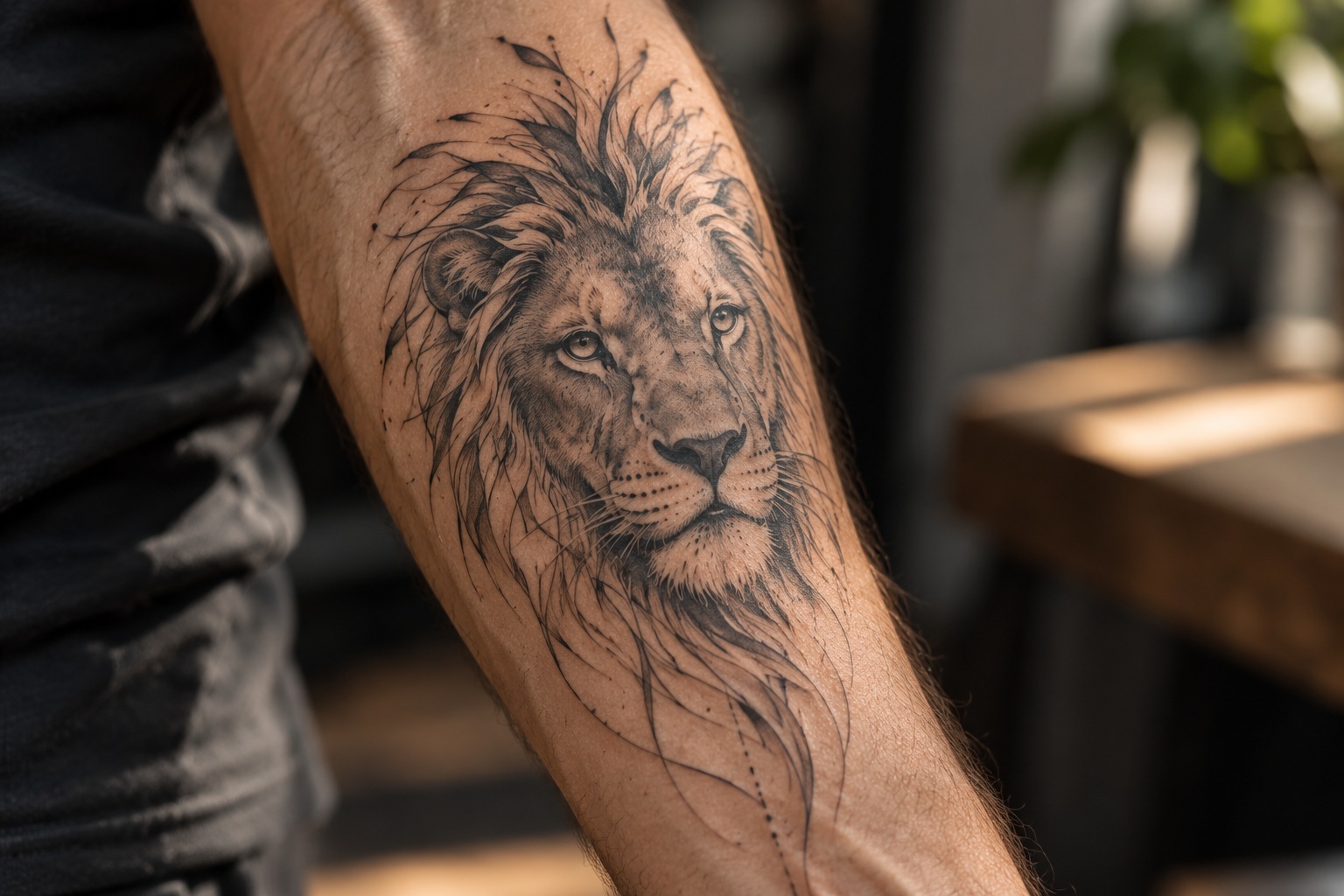
A fine-line lion face strips the concept down to its most recognizable features. Delicate outlines around the eyes, nose and mane can create a confident design without heavy shading. This approach works especially well for someone who likes animal tattoos but prefers a lighter visual style.
2. Calm Lion Profile
Instead of the classic roaring lion, choose a relaxed side profile. The calm expression changes the symbolism from outward aggression to controlled strength. It is a strong choice for the forearm, upper arm, shoulder or calf.
3. Lion With an Open, Flowing Mane
Let the mane become the main artistic feature. Long curved lines can follow the natural shape of the arm, shoulder or thigh. The face can remain relatively simple while the mane creates movement and scale.
4. Half Lion Face
A cropped half-face composition can feel more contemporary than a centered portrait. One eye, part of the muzzle and a section of mane are enough to make the animal immediately recognizable. This also creates room for negative space.
5. Tiny Lion Silhouette
Not every symbol of courage needs to be large. A small standing or walking lion silhouette can work on the wrist, ankle, upper arm or back of the arm. Keeping the outline simple helps the shape remain readable at a smaller scale.
6. Lion and Wildflower Tattoo
Wildflowers soften the visual weight of a lion without taking away its meaning. A few delicate stems can cross the bottom of a lion portrait or emerge naturally from the mane. Choose flowers that have personal significance rather than adding them simply as filler.
7. Lioness Tattoo
A lioness can symbolize protection, independence, resilience and fierce devotion to family. A quiet portrait often feels especially powerful because it does not rely on exaggerated expressions to communicate strength.

8. Lion With Botanical Mane
Replace portions of the traditional mane with leaves, branches or small flowers. The botanical elements can be subtle enough that the lion remains the main subject while giving the tattoo an organic, customized appearance.
9. Geometric Lion Tattoo
Geometric lines can frame a realistic or simplified lion portrait. Circles, triangles and restrained line structures add visual organization. The strongest versions use geometry as a supporting element rather than covering the lion with unnecessary shapes.
10. Single-Line Lion
A continuous-line interpretation is ideal for a minimalist aesthetic. One flowing line can suggest the forehead, muzzle and mane without rendering every detail. Because simplified designs depend heavily on proportion, clean drawing matters more than complexity.
11. Lion Eyes Tattoo
Focusing only on the eyes creates an intense design without requiring a full portrait. This idea can represent focus, awareness or determination. It works particularly well as a horizontal composition on the forearm or upper back.
12. Lion With a Crescent Moon
A thin crescent moon adds a quieter celestial dimension to a lion design. It can sit behind the profile, appear above the mane or become part of a small framed composition. Sparse stars or dots can finish the design without making it busy.
13. Lion and Sun Tattoo
A simple sun behind a lion profile can suggest vitality, endurance, renewal or confidence. Fine rays produce a lighter appearance, while heavier blackwork creates a stronger graphic effect.
14. Lion With Mountain Linework
Combine a lion with a restrained mountain outline for a tattoo centered on perseverance and resilience. Rather than placing a complete landscape beside the animal, allow a thin ridgeline to intersect the mane or frame the lower portion of the design.
15. Abstract Lion Mane
Keep the face recognizable while allowing the mane to dissolve into brush-like marks, broken lines or loose curves. The contrast between recognizable anatomy and abstraction can give a familiar subject a much more artistic appearance.
16. Small Lion Behind the Arm
The back of the upper arm is a useful location for a small or medium vertical lion design. A narrow profile or simplified face can follow the natural length of the area and remain relatively discreet from the front.
17. Lion Shoulder Tattoo
The rounded shoulder provides room for a lion portrait with a broader mane. Instead of treating the design like a flat picture, ask your artist to consider how the mane can wrap naturally toward the upper arm or shoulder blade.
18. Lion Forearm Tattoo
The forearm works especially well for an elongated lion composition. A side profile can follow the arm vertically, while a frontal face can be adapted to the available width. Keep the smallest details large enough to remain visually separated.

19. Lion Chest Tattoo
A chest placement gives a lion tattoo enough room to become a substantial statement piece. A profile can follow one side of the chest, while a centered composition can create symmetry. This placement suits designs where the mane needs more breathing room.
20. Lion Calf Tattoo
The calf offers a long, relatively broad canvas for detailed animal work. A vertical lion face, walking silhouette or lion-and-landscape composition can fit naturally here without forcing the design into a tiny space.
21. Lion With Roman Numerals
If a date matters to the symbolism, restrained Roman numerals can be incorporated beneath the lion or along one edge of the composition. Keep the lettering secondary so the design does not become visually crowded.
22. Lion With Minimal Script
A short word can reinforce the personal meaning of the lion. Consider concepts such as courage, endure, rise or a word with private significance. Small script usually works best when it has enough space around it instead of crossing through detailed mane work.
23. Lion Family Tattoo
A larger lion with one or more smaller silhouettes can represent family and protection without relying on names or portraits. Keeping the figures simple can prevent the piece from becoming overly literal.
24. Lion and Cub Tattoo
A lion with a cub can represent parenthood, guidance and protection. A side-profile composition often feels more natural than arranging both animals to face directly outward. The interaction between the two figures can carry most of the emotional meaning.
25. Blackwork Lion Tattoo
For a stronger graphic appearance, use solid black shapes and controlled negative space. Blackwork can emphasize the mane, eyes and facial structure without requiring photorealistic detail. The result can feel bold while remaining clean.
26. Fine-Line Lioness With Flowers
A fine-line lioness surrounded by two or three restrained botanical elements balances strength with softness. Instead of building a complete floral frame, leave open space around the face so the animal remains the focus.
27. Lion Emerging From Negative Space
Rather than outlining the entire animal, allow portions of the face and mane to disappear into untouched skin. Your eye completes the missing information. This can create a sophisticated design while reducing unnecessary line density.
28. Sketch-Style Lion
Loose, energetic lines can give the tattoo the appearance of an artist’s preliminary drawing. A few deliberate construction marks and broken mane strokes make the design feel expressive rather than polished into perfect symmetry.

29. Micro-Realism Lion Portrait
A compact realistic lion portrait can be impressive, but scale needs careful consideration. Tiny facial features and densely packed fur textures leave less room between marks. Discuss how much detail is appropriate for the final size instead of simply shrinking a large portrait concept.
30. Custom Symbolic Lion Composition
For the most personal option, start with the lion’s meaning and build a custom composition around it. Your artist might combine a calm profile with a significant flower, a simple celestial symbol, a date or an abstract element. Limiting the design to one or two supporting ideas can make it feel more intentional than combining every symbol you like.
Best Lion Tattoo Placement Options
Lion tattoo placement should be chosen together with the composition. Detailed animal faces generally benefit from more room, while minimalist silhouettes and linework can work in narrower locations.
- Forearm: Good for elongated profiles, fine-line lions and medium-size portraits.
- Upper arm: Versatile for both discreet and bold designs, with enough width for a recognizable mane.
- Shoulder: Particularly effective when the mane is designed around the body’s natural curve.
- Chest: Offers more room for larger symbolic compositions.
- Back: Suitable for expansive designs and more complex supporting elements.
- Calf: Provides a useful vertical canvas for portraits and walking lions.
- Thigh: Gives detailed designs substantial room while allowing them to remain easy to cover.
- Wrist or ankle: Better suited to simplified silhouettes and small linework than dense realism.
Bring both design inspiration and placement photos to your consultation. A good artist can adapt the concept to the anatomy instead of simply resizing a rectangular reference image.
The Detail Mistake That Can Make a Lion Tattoo Too Busy
Lions invite detail. There is fur, a large mane, expressive eyes, whiskers, shadows and facial texture. It is tempting to include all of it, particularly when working from a dramatic photograph.
The problem is that visual complexity needs physical space. Packing numerous tiny marks into a small lion can make the composition difficult to read even before you consider how a tattoo changes over time.
A stronger approach is to establish a hierarchy. Decide what viewers should notice first. If the eyes are the focal point, the mane can be simpler. If the flowing mane is the main feature, the facial shading does not necessarily need equal complexity.
Ask your tattoo artist which details contribute to the design and which can be removed without losing the lion’s character. Simplification is not the same as making a tattoo boring. Often it is what gives the strongest features room to stand out.
Fine-Line vs. Realistic Lion Tattoos
Fine-line and realistic lion tattoos can communicate the same symbolism while producing very different visual results.
A fine-line lion tattoo uses restrained outlines, delicate facial features and open skin. It tends to feel lighter and works naturally with botanical, geometric and celestial details. It can also suit someone who wants the lion symbolism without a visually heavy tattoo.
A realistic lion tattoo relies more heavily on tonal variation, recognizable anatomy, texture and dimensional shading. It usually benefits from additional space so the artist can separate the eyes, nose, muzzle and mane effectively.
There is also a useful middle ground. A tattoo can have a realistically drawn face combined with a simplified mane, or detailed eyes paired with loose sketch-style lines. Mixing approaches can produce a lion tattoo design that feels less predictable.
How to Plan Your First Lion Tattoo
If this is your first tattoo, start with the concept rather than trying to finalize every visual detail yourself. Your goal is to give the artist a clear direction while leaving enough flexibility for the artwork to be adapted professionally.
- Define the meaning. Write down why you want a lion specifically and what you want it to represent.
- Choose the mood. Decide whether the lion should feel calm, protective, watchful, bold, fierce or abstract.
- Pick a general style. Save references for fine-line, blackwork, realism, illustrative or geometric work.
- Choose a placement range. Consider visibility, available space and how the shape will interact with your body.
- Set a realistic size. Allow enough room for the amount of detail you want.
- Find an artist whose portfolio fits the style. Look at healed work where available, not only freshly completed tattoos.
- Request an original composition. Use saved images to communicate preferences rather than asking for an exact copy of another person’s tattoo.
How to Choose the Right Lion Tattoo Artist
The artist matters as much as the concept, especially when the design includes animal anatomy, fine-line details or realistic shading. Look through portfolios for work that resembles the technique you want rather than choosing solely because an artist has tattooed lions before.
If you want fine-line work, examine the consistency of curves, facial features and small details. For realism, pay attention to contrast, facial proportions and whether the fur has structure instead of appearing as an indistinct mass of texture.
During the consultation, explain your symbolism, placement, approximate size and the features you want emphasized. A useful reference collection might include one image for the preferred facial expression, another for linework, another for composition and a placement photo.
This gives the artist direction without asking them to reproduce someone else’s tattoo.

Questions to Ask Before You Book
A short consultation can resolve many design problems before the appointment. Consider asking:
- Is my preferred size large enough for this amount of detail?
- How would you simplify the mane while keeping the lion recognizable?
- Would this design fit the forearm, shoulder or upper arm better?
- Which parts of the design should have the strongest contrast?
- Can the composition follow the shape of the body more naturally?
- Do the additional symbols improve the design, or should some be removed?
- How will the placement affect the direction the lion faces?
These questions focus the conversation on the actual tattoo rather than just the reference image.
Choosing a Lion Tattoo You Will Still Like Later
The most memorable lion tattoo ideas are not necessarily the largest or most detailed. They are the ones where symbolism, placement and visual style support one another.
If strength is your main theme, decide what strength means to you before choosing the lion’s expression. If courage matters more, a calm lion may communicate your idea better than an aggressive one. If family is central, a lioness, cub or subtle secondary symbol may give the design greater personal significance.
Most importantly, give the design room to breathe. You do not need a crown, clock, rose, compass, mountains, dates and a full landscape simply because all of those elements can work with a lion. One carefully chosen detail can say more than six competing symbols.
Save the concepts that immediately connect with your reason for getting the tattoo, then look at them again after a few days. Once you know which elements still feel important, take those references to an artist whose work fits the style. That process gives you a much better starting point for creating a lion tattoo that represents strength and courage without feeling generic.