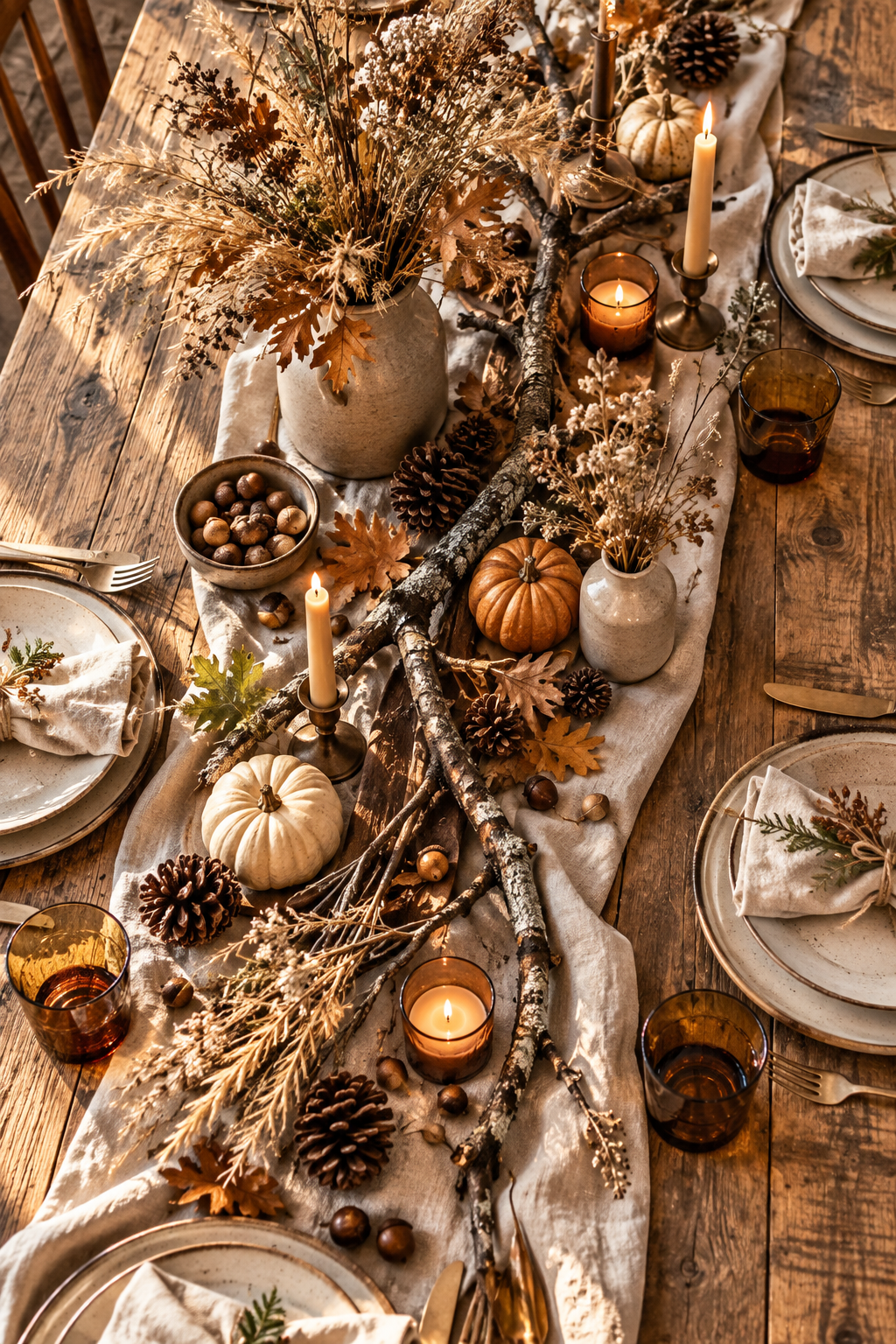
Rustic Harvest Tablescape Decor Using What Nature Already Gives You
A beautiful fall table does not need to begin with a cart full of new decorations. Some of the most convincing rustic harvest tablescape decor comes from materials that already exist outdoors: fallen branches, dried grasses, pinecones, acorns, colorful leaves, seed heads, and other seasonal finds.
Foraged materials work especially well for harvest decorating because their irregular shapes and imperfect textures make a table feel relaxed rather than overly styled. A slightly crooked branch, a handful of weathered acorns, or dried grass with uneven stems can provide more character than a perfectly coordinated set of store-bought decorations.
The key is editing. A rustic table should feel natural without looking as though the contents of the yard were emptied across the dining table. By repeating a limited palette, keeping arrangements low, and leaving enough open space for plates and serving dishes, you can turn simple natural finds into intentional fall decor.
These 18 ideas range from almost effortless arrangements to slightly more layered tablescapes, making them useful whether you are setting a casual weeknight dinner, Thanksgiving table, Friendsgiving gathering, or autumn dinner party.
Before You Forage: Keep the Table Practical and Clean
Before collecting materials, decide what your table actually needs. If dinner will be served family-style, reserve room for platters and bowls. If food will be served elsewhere, you can create a fuller centerpiece. This prevents you from building an arrangement that looks beautiful for five minutes but has to be dismantled before anyone sits down.
Collect only materials you can identify and gather legally and responsibly. Avoid protected plants, private property without permission, and anything visibly moldy, heavily damp, insect-infested, or treated with chemicals. Shake debris outdoors and inspect everything carefully before bringing it inside.
For materials that will sit near food, use clean dishes, trays, linens, or containers as barriers rather than placing questionable outdoor finds directly against food or eating surfaces.
1. Create a Loose Branch Runner
Instead of buying a traditional fabric runner, build a visual runner from a few slender fallen branches. Choose branches with interesting forks and gentle curves rather than thick pieces that dominate the table.
Arrange them lengthwise through the center, allowing their shapes to overlap slightly. Leave gaps between them instead of creating one dense pile. The open structure makes the arrangement look deliberate and leaves room for candles, small pumpkins, or serving pieces.
This approach is particularly effective on a raw or weathered wood table because the similar materials create a cohesive rustic look while the branch silhouettes add dimension.
2. Gather Dried Grasses Into Small Bundles
Dried grasses can provide softness that balances the harder surfaces of wood, ceramic, glass, and pinecones. Rather than creating one oversized bouquet, divide the grasses into several small bundles.
Tie each bundle loosely with natural twine and trim the stems so they sit comfortably on the table. Place one near the centerpiece and use smaller bundles near place settings if space allows.
Keep the bundles airy. Their movement and uneven height are part of what makes foraged tablescape ideas feel authentic.
3. Scatter Pinecones Along the Centerline
Pinecones are an easy way to add recognizable autumn woodland texture without introducing another strong color. Their warm brown tones work naturally with cream linens, raw wood, amber glass, and matte ceramics.
Instead of creating a solid mound, place pinecones individually or in groups of three along the center of the table. Vary their sizes and orientations so the arrangement does not feel mechanically symmetrical.
A restrained scattering usually looks more sophisticated than covering every available inch.
4. Use Acorns as Tiny Natural Accents
Acorns are small enough to fill visual gaps without making the table feel crowded. Gather a handful and place them around the bases of candleholders, beside miniature pumpkins, or along a simple centerpiece runner.
Their small scale is especially helpful on compact dining tables where larger fall decorations can quickly interfere with place settings.
You can also place a few in a shallow matte ceramic dish for a simple contained display.
5. Make Fallen Leaves Part of Each Place Setting
A single attractive leaf can become an understated seasonal detail. Look for leaves with interesting shapes and warm muted colors rather than trying to find perfectly identical specimens.
Place one beside each napkin or tuck a small dried leaf under a loosely tied piece of twine. Keep the rest of the place setting simple so the natural element remains noticeable.
Using leaves individually rather than scattering dozens across the table also helps prevent a natural fall table setting from becoming visually messy.
6. Fill a Matte Ceramic Vessel With Foraged Branches
If you already own a neutral vase, pitcher, or matte ceramic vessel, turn it into the anchor of your tablescape. Add several thin branches with sparse foliage or seed heads and allow their natural shapes to determine the arrangement.
Avoid forcing every stem into a symmetrical bouquet. Rustic arrangements usually look better when one branch extends farther than another and the overall silhouette remains loose.
Keep the arrangement low enough for seated guests to see across the table, or move a taller vessel to one end if conversation space is important.
7. Combine Weathered Wood With Neutral Linen
Rustic does not have to mean rough everywhere. Contrast weathered wood with soft neutral fabric to make natural materials feel more comfortable and intentional.
Try an oatmeal, flax, cream, or muted taupe runner over a wooden dining table. If you do not own a runner, a narrow folded length of simple linen-look fabric can create a similar effect.
Let the fabric wrinkle naturally rather than pressing it perfectly flat. The slight irregularity works well with branches, dried foliage, and other organic textures.
8. Use Seed Heads for Sculptural Texture
Dried seed heads are often overlooked, but their unusual shapes can add visual interest without requiring bright flowers. Place a few in a small bottle, ceramic cup, or narrow vase.
They work particularly well in a neutral tablescape where shape and texture matter more than color. Choose only a few varieties so the table does not become visually chaotic.
Seed heads can also be combined with dried grasses to create small arrangements repeated along a long table.
9. Build a Low Centerpiece Instead of a Tall Bouquet
A harvest table should still function as a dining table. Tall arrangements may photograph beautifully, but they can block conversation and take up valuable serving space.
Build a low centerpiece by layering a branch, several pinecones, dried leaves, and a few small vessels along the centerline. Keep most of the arrangement below eye level when guests are seated.
This creates a full visual effect without turning dinner into a conversation around a floral obstacle.
10. Add Small Pumpkins Sparingly
Pumpkins immediately communicate fall, but you do not need a dozen of them. Two or three miniature pumpkins mixed into foraged materials are often enough.
Look for muted orange, cream, tan, or naturally variegated varieties that coordinate with your existing palette. Place them at slightly different positions rather than forming a perfectly centered row.
The goal is to let the pumpkins support the foraged materials rather than allowing them to become the entire theme.
11. Create a Foraged Place Card Detail
For a dinner party or Thanksgiving table, natural materials can make simple place cards feel special. Write each guest’s name on a small piece of neutral cardstock and pair it with a dried leaf, tiny sprig, or small seed head.
Secure the pieces with a short length of twine or place the natural element beside the card. You do not need elaborate calligraphy. Simple handwriting suits the relaxed nature of rustic table decor.
Keep each accent small enough that guests can easily move it when dinner begins.
12. Mix Clear or Amber Glass With Natural Materials
Glass provides a useful contrast to rough natural textures. Small clear bottles or amber glass vessels can hold individual dried stems while allowing light to move through the arrangement.
If you already have mismatched bottles or jars, group them in odd numbers and vary their heights slightly. Avoid filling every vessel. A few intentionally empty spaces help the table breathe.
Amber glass is particularly effective during late-afternoon or evening meals because warm light emphasizes its autumn tones.
13. Repeat One Foraged Material Across the Table
One of the easiest ways to prevent a foraged arrangement from looking random is repetition. Choose one material—such as acorns, pinecones, oak leaves, or dried grasses—and repeat it in several locations.
For example, a few pinecones can appear beside the centerpiece, near each end of the table, and alongside a small serving arrangement. Repetition visually connects the different sections of the tablescape.
This technique is especially useful if you are combining several mismatched dishes or vessels.
14. Keep Your Color Palette Restrained
Nature provides plenty of color, but that does not mean every color needs to appear on the table. A limited palette makes inexpensive materials look much more intentional.
For a classic harvest look, combine warm brown, oatmeal, cream, muted orange, and faded green. For something moodier, use weathered wood, deep brown foliage, amber glass, and matte black accents.
Once you choose a palette, remove natural finds that strongly compete with it. Editing is often more important than adding another decoration.
15. Add Candlelight Between Foraged Elements
Candlelight makes natural textures more noticeable, particularly during an evening harvest dinner. Place simple candleholders between sections of branches, pinecones, or dried grasses rather than concentrating all the candles in one area.
Keep flames safely separated from dry plant material. Battery-operated candles are another option when you want warm light close to dried foliage without an open flame.
The combination of warm illumination, rough wood, matte ceramic, and dried botanicals creates a layered table without requiring many decorative pieces.
16. Let Imperfect Materials Stay Imperfect
One of the biggest advantages of foraged decor is that it does not need to look manufactured. Do not worry if every pinecone is a different size, the branches curve in unexpected directions, or dried leaves have faded unevenly.
Those variations create the visual texture that makes the arrangement interesting.
The trick is to balance imperfection with structure. Repeat colors, maintain open space, and keep the overall arrangement within a defined central area. That framework allows individual pieces to remain irregular without making the table look accidental.
17. Create Small Clusters Instead of One Continuous Pile
If your first attempt at a foraged tablescape looks messy, the problem may be distribution rather than the materials themselves. Spreading dozens of small objects evenly across a table can create visual clutter.
Instead, organize materials into small clusters. Combine one miniature pumpkin, two pinecones, a branch, and a small group of acorns. Leave open space, then repeat a related cluster farther down the table.
This simple change creates rhythm and gives the eye somewhere to rest. It also makes it easier to remove individual clusters when you need additional space for food.
18. Finish With One Unexpected Natural Detail
After the basic tablescape is complete, add one element that makes the table feel specific to your surroundings. It might be an unusually shaped branch, a handful of beautiful seed pods, a cluster of weathered nuts, or a particularly interesting piece of dried foliage.
Use the unexpected material sparingly. One distinctive natural detail has more impact than several competing focal points.
This is also what makes foraged decorating feel personal. Instead of recreating the exact same seasonal display found in a store, you are using materials connected to the landscape and season around you.
How to Make Foraged Decor Look Intentional Instead of Messy
The most common problem with foraged decorating is using too much. Natural materials already contain irregular lines, varied colors, and complex textures. When too many are combined without structure, the result can quickly feel cluttered.
A useful rule is to select three primary natural materials and let everything else play a supporting role. For example, you might build the main arrangement around branches, dried grasses, and pinecones, then add only a few leaves or acorns as smaller accents.
Use these principles to keep the finished table cohesive:
- Repeat materials: Use the same natural element in several places instead of introducing something different everywhere.
- Leave negative space: Empty tabletop is part of the composition and makes textured materials easier to appreciate.
- Vary height carefully: Combine low objects with a few slightly taller stems instead of making every section the same height.
- Limit the palette: Choose a small family of warm, earthy colors.
- Group small objects: Acorns and pinecones usually look more intentional in clusters than evenly scattered across the entire table.
- Protect conversation space: Keep the center low enough for guests to see each other comfortably.
A Simple Step-by-Step Foraged Harvest Tablescape
If this is your first time decorating with natural materials, start with a simple formula instead of trying to incorporate every idea at once.
- Clear the table completely. Starting with an empty surface makes it easier to judge scale.
- Add a neutral base. Use the bare wood tabletop or a simple linen runner.
- Position one main branch. Place it lengthwise through part of the center rather than perfectly centered.
- Add two or three small vessels. Fill them loosely with dried grasses or seed heads.
- Create small clusters. Add pinecones, acorns, miniature pumpkins, or leaves in restrained groups.
- Introduce warm light. Position candles or safe battery-operated lights between the clusters.
- Set the plates and serving pieces. Check whether the arrangement still leaves enough usable space.
- Remove one or two unnecessary items. Editing at the end often makes the entire table look more polished.
Once the basic arrangement works, you can add place cards, individual leaves, or other small details without changing the overall structure.
What You Probably Do Not Need to Buy
The appeal of rustic harvest tablescape decor is that the natural materials do most of the decorative work. Before shopping, check your kitchen cabinets, linen storage, and other rooms for items that can be repurposed.
Neutral plates, clear glasses, small jars, ceramic bowls, old wooden boards, simple candleholders, cotton napkins, and even plain twine can become part of the table. They do not need to match perfectly.
In fact, a combination of slightly different ceramic pieces often complements foraged materials better than a perfectly coordinated seasonal dinnerware set.
If you do purchase anything, prioritize something reusable throughout the year, such as neutral linens or simple candleholders, rather than highly specific harvest decorations that spend most of the year in storage.
Make Your Harvest Table Feel Collected, Not Purchased
A memorable fall table is not necessarily the one with the most decorations. It is the one where materials, textures, and colors feel connected.
Foraged branches can establish the structure. Dried grasses bring softness. Pinecones, acorns, seed heads, and leaves provide smaller layers of texture. Neutral linens and ceramics calm everything down, while warm candlelight helps the entire arrangement feel inviting.
Most importantly, resist the temptation to fill every empty spot. Natural materials become more striking when they have space around them.
With a few carefully gathered finds and items you already own, you can create a natural fall table setting that feels seasonal without looking overly themed. The imperfections are what give this style its character: crooked branches, weathered wood, faded foliage, irregular pinecones, and loosely arranged grasses all contribute to a table that feels warm, relaxed, and genuinely connected to the harvest season.