
24 Leopard Tattoo Ideas With Bold Symbolism
A leopard tattoo has an immediate presence. Even when the design is small, the animal’s distinctive spots, alert expression, and powerful silhouette can make the piece feel confident without needing excessive detail. For anyone searching for leopard tattoo ideas with both visual impact and personal significance, there are far more options than a straightforward realistic portrait.
Leopards can represent independence, adaptability, patience, confidence, stealth, resilience, and personal power. Those themes can be expressed through everything from a detailed leopard face to a tiny fine-line silhouette or a few carefully placed rosettes. The best design is not necessarily the largest or most complicated. It is the one where the style, placement, scale, and symbolism work together.
If you want a leopard tattoo that feels distinctive rather than generic, these 24 ideas offer different ways to approach the animal while keeping the finished piece wearable and meaningful.
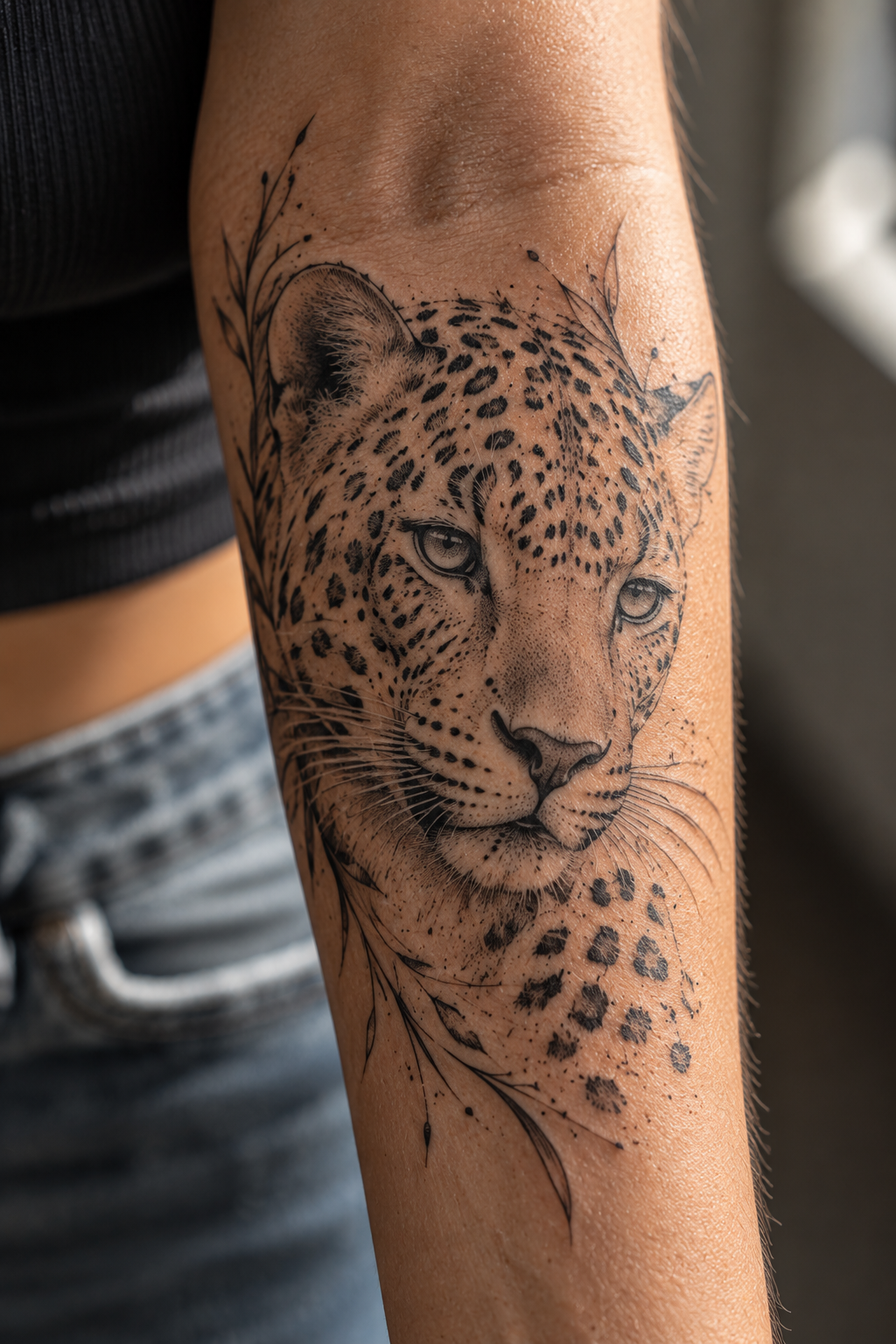
What Does a Leopard Tattoo Mean?
Leopard tattoo meaning can vary considerably from one person to another. The leopard is often associated with strength, but its symbolism is more nuanced than simple physical power. Unlike imagery that depends on aggression, a leopard can suggest controlled confidence: knowing when to move, when to wait, and when to protect your space.
The animal can also work as a symbol of independence. Leopards are frequently imagined as solitary, self-sufficient animals, making the motif appealing to someone who values autonomy or has learned to rely on personal resilience.
Adaptability is another strong interpretation. A leopard-inspired tattoo can mark a period of change, survival, reinvention, or learning how to remain yourself while circumstances around you shift.
- Strength: Quiet power and the ability to protect yourself.
- Independence: Confidence in following your own direction.
- Adaptability: Remaining capable through changing circumstances.
- Patience: Knowing that strength does not always need to be loud.
- Individuality: Owning the characteristics that make you recognizable.
- Resilience: Continuing forward after difficult periods.
Your tattoo does not need to represent every one of these qualities. Choosing one clear idea often gives a leopard tattoo design more personal weight.
1. Realistic Leopard Portrait
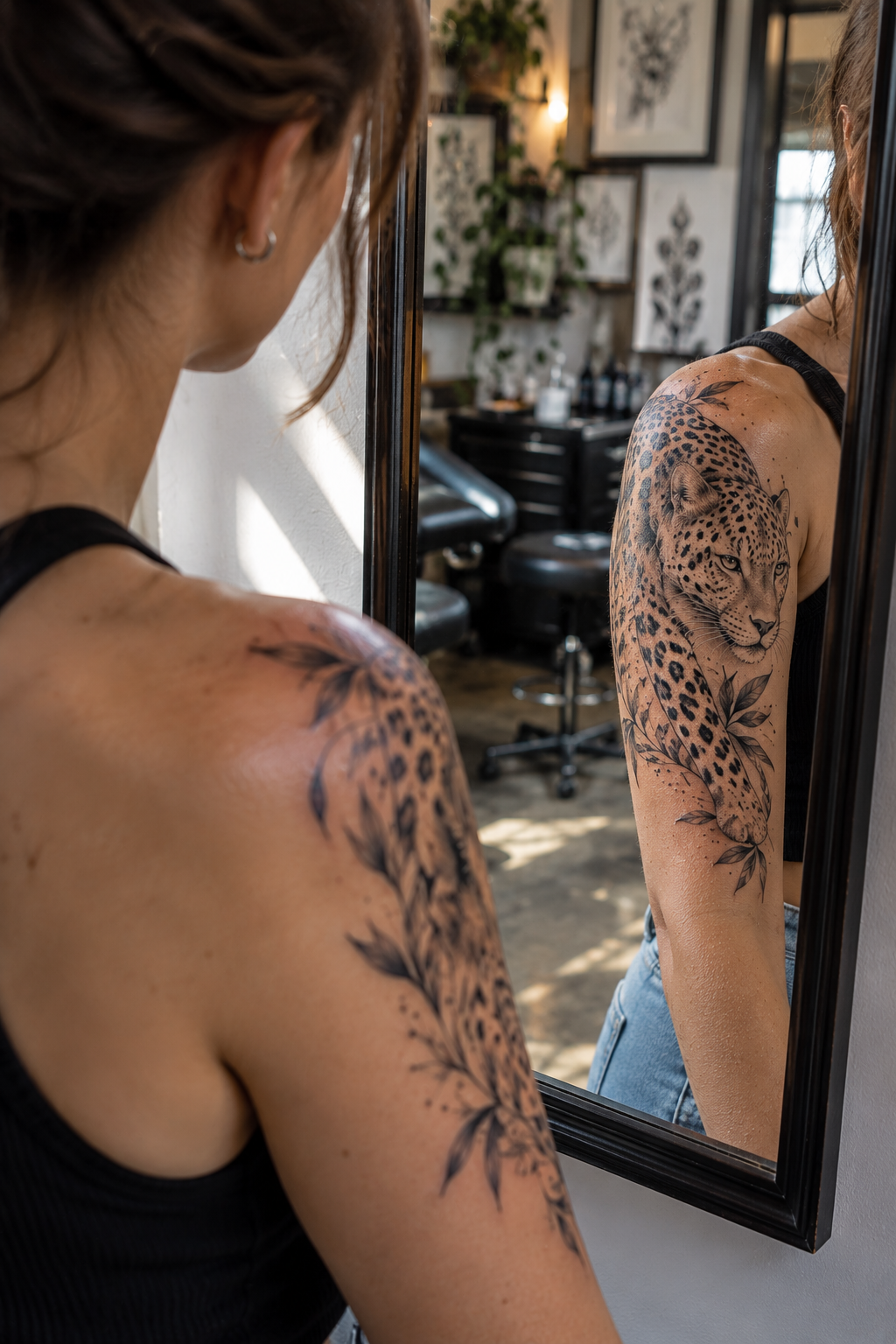
A realistic portrait is one of the boldest ways to use leopard imagery. The face can include detailed eyes, whiskers, fur, and carefully spaced rosettes. Because realism requires room for tonal variation, this design generally works better at medium or large scale.
The upper arm, thigh, shoulder blade, and outer forearm provide useful space. A direct gaze creates a powerful composition and can symbolize confidence, awareness, and self-possession.
2. Fine-Line Leopard Face
For something lighter, reduce the animal to its essential facial structure. Thin lines can suggest the ears, eyes, nose, and a limited number of spots without filling every section with detail.
This approach is particularly attractive if you like recognizable animal imagery but do not want a heavy tattoo. Keep enough negative space around the features so the design remains visually clear.
3. Walking Leopard Tattoo
A walking leopard creates a long, graceful shape that naturally suits the forearm, calf, ribcage, or upper arm. The extended body gives the tattoo a sense of movement rather than making it feel like a static emblem.
Symbolically, the walking pose can represent moving with intention, trusting your instincts, or quietly pursuing your own path.
4. Leopard Eyes Tattoo
You do not need the entire animal to create a recognizable piece. A pair of leopard eyes surrounded by restrained spot details can make an intense but relatively compact tattoo.
This design can represent observation, intuition, awareness, or the ability to recognize what others overlook. It works especially well when the eyes remain the visual focal point.
5. Minimal Leopard Silhouette
A simple silhouette strips the idea down to posture and shape. Consider a tiny walking leopard, a resting cat, or an animal perched along a narrow branch.
Minimal silhouettes can work on the ankle, wrist, upper arm, or shoulder. They are useful for someone who wants big cat tattoo ideas without committing to a large realism piece.
6. Leopard Spot Band
Instead of tattooing the whole animal, use its distinctive rosettes as the design. A loose band of leopard spots can wrap partially around the arm, ankle, or thigh.
A partial wrap usually feels more organic than a perfectly uniform band. Varying the size and spacing of the rosettes can also prevent the pattern from looking overly mechanical.
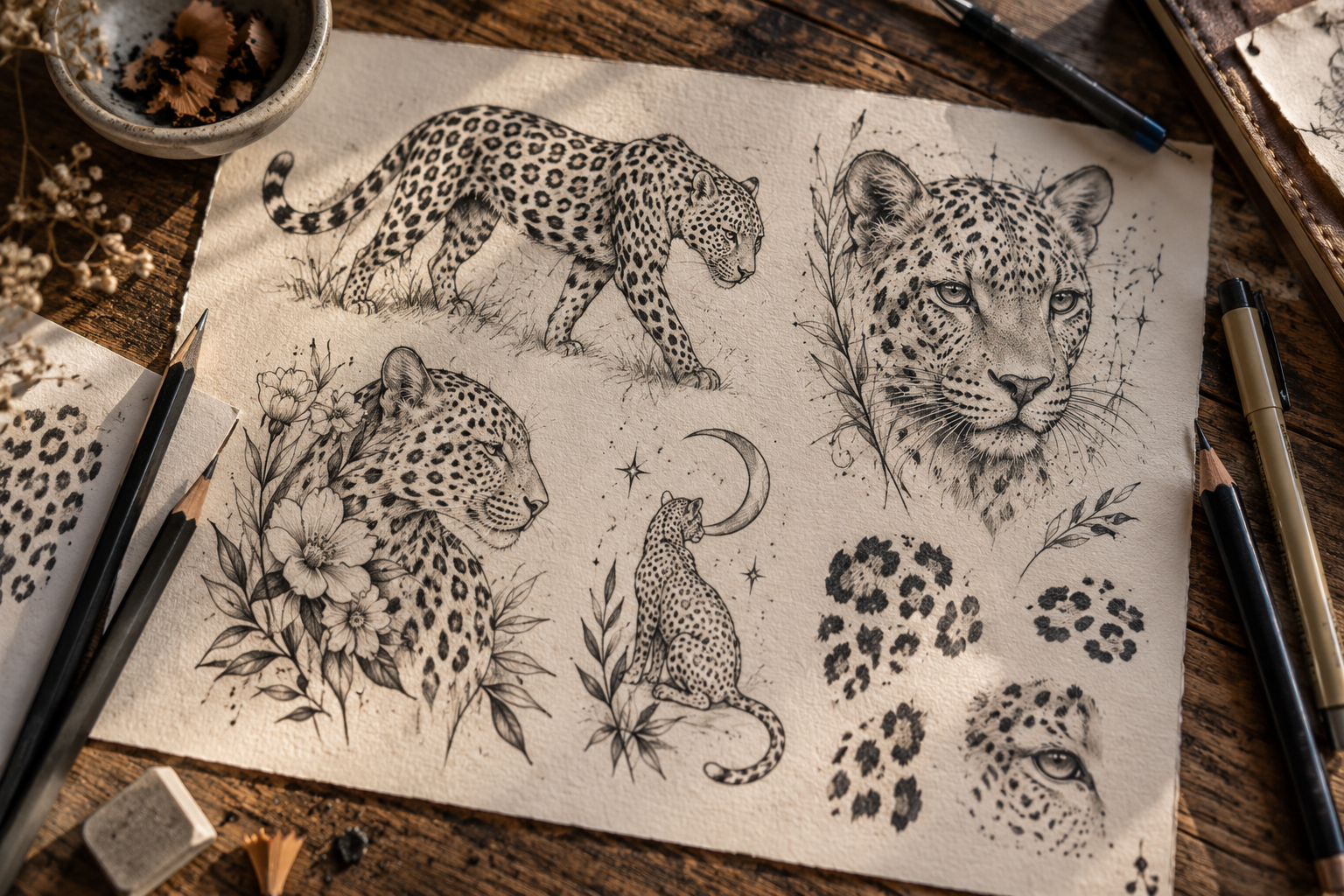
7. Leopard With Wildflowers
Combining a leopard with wildflowers creates an effective contrast between strength and softness. The animal can remain central while stems and flowers frame the face or follow the movement of the body.
The flowers can add another symbolic layer. Choose blooms connected to remembrance, growth, a birth month, or a meaningful place rather than adding botanical details purely as filler.
8. Leopard and Crescent Moon
A crescent moon can make a leopard tattoo feel more mysterious without pushing the design into an overly elaborate composition. A small leopard beneath a thin crescent is especially effective for fine-line work.
The pairing can symbolize intuition, cycles, independence, or personal transformation. It also works well for anyone drawn to subtle celestial tattoos.
9. Leopard Resting on a Branch
A resting leopard offers a different interpretation of strength. Instead of showing movement or aggression, the animal appears calm and completely at ease.
This can represent security, patience, confidence, or learning that power does not require constant action. A horizontal composition works well on the upper arm, thigh, or shoulder blade.
10. Geometric Leopard Tattoo
Geometric framing can give traditional animal imagery a more contemporary edge. A leopard face might intersect with a circle, diamond, arch, or several restrained straight lines.
Keep the geometry secondary to the animal. Too many intersecting shapes can compete with the spots and facial details, particularly at smaller sizes.
11. Leopard With Botanical Leaves
Leaves are an alternative to floral elements if you prefer an earthy, understated design. Ferns, olive-like branches, tropical foliage, or simple fine-line leaves can frame the leopard without making the tattoo overly decorative.
The combination can suggest wildness, growth, endurance, and a connection to nature.
12. Tiny Leopard Ankle Tattoo
A tiny leopard can look surprisingly distinctive when the artist focuses on silhouette instead of trying to reproduce every spot. A walking side profile is one of the clearest choices at this scale.
The ankle provides a discreet location that can be visible or covered depending on footwear. For very small work, simplify the rosettes and facial details so the tattoo does not depend on tiny marks for readability.
13. Leopard Shoulder Tattoo
The shoulder gives an artist a rounded surface that can complement the natural movement of a leopard. A portrait can sit across the outer shoulder, while a walking animal can curve slightly toward the upper arm.
This is also a useful location if you might eventually expand the piece into a larger botanical or wildlife composition.
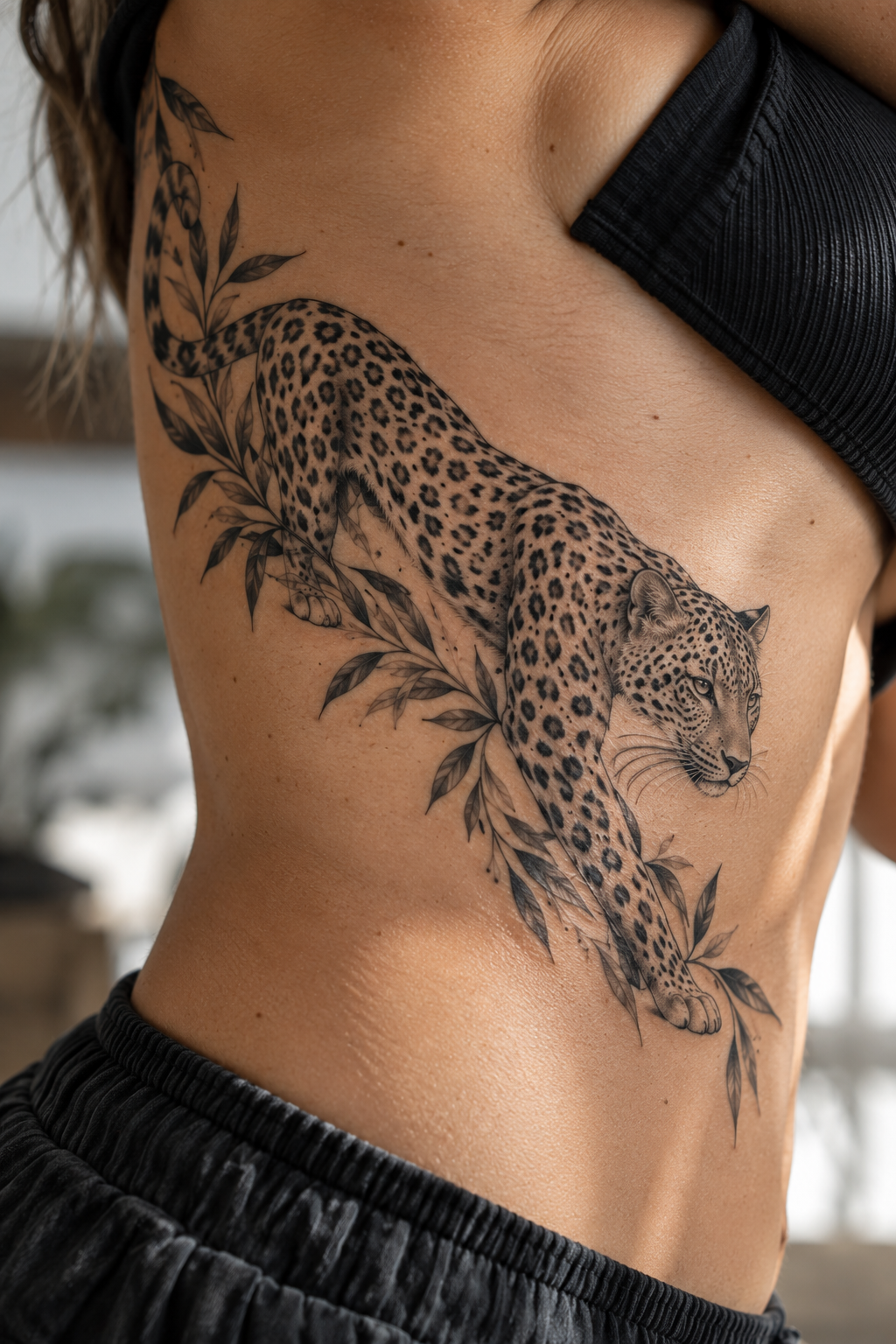
14. Leopard Rib Tattoo
The ribcage suits elongated leopard designs beautifully. A walking or climbing animal can follow the vertical direction of the torso, while a botanical composition can curve with the body’s natural shape.
Because ribs move as you breathe, thoughtful stencil placement is important. Look at the design while standing naturally rather than judging it only while your body is stretched into position.
15. Leopard Thigh Tattoo
The thigh provides enough room for detailed leopard tattoo ideas without forcing the artwork into a cramped area. It is particularly suitable for realistic portraits, full-body animals, and designs surrounded by foliage.
A larger canvas also lets the artist create cleaner spacing between rosettes, fur texture, shadows, and facial features.
16. Fine-Line Leopard With Stars
Small stars or celestial dots can turn a minimalist leopard into a more dreamy composition. Keep the stars sparse so they support rather than overwhelm the animal.
This version works nicely on the forearm, shoulder, ankle, or upper arm and can symbolize independence combined with direction, hope, or curiosity.
17. Leopard Head With Open Mouth
For a much stronger statement, an open-mouth leopard can communicate protection, courage, defiance, or fierce boundaries. This style is naturally more dramatic than a calm portrait.
The mouth, teeth, nose, and spots create substantial visual information, so avoid shrinking this design too far. Medium and large placements tend to preserve the expression more successfully.
18. Half Realistic, Half Linework Leopard
A split-style composition can combine detailed realism on one side with simplified linework on the other. The contrast makes the design feel contemporary while keeping the leopard immediately recognizable.
It can also carry symbolic meaning: instinct and reason, softness and strength, the past and the future, or two different parts of your personality existing together.
19. Leopard Paw Print Tattoo
A paw print offers a quieter alternative to a portrait. It can be rendered as a small black silhouette, fine-line outline, or textured impression.
This works particularly well if your preferred symbolism centers on movement, leaving a mark, independence, or continuing forward after a major transition.
20. Leopard With a Sun Motif
Pairing the leopard with a simple sun creates a design centered on vitality and confidence. A rising sun behind a walking animal can create a particularly strong silhouette.
Keep the rays relatively simple if the leopard already contains detailed spots. Strong compositions usually establish one dominant element rather than giving every part equal visual weight.
21. Ornamental Leopard Tattoo
Ornamental linework can surround a leopard face with symmetrical curves, fine dots, and decorative shapes. The result can feel elegant without reducing the animal’s strength.
This approach is particularly suited to the upper back, sternum area, thigh, or forearm, where symmetry has enough space to remain visible.
22. Leopard Emerging From Leaves
Rather than showing the entire animal, let a leopard’s eyes and face appear between overlapping leaves. The composition can create the impression of an animal quietly watching from its environment.
It is an effective design for symbolism related to patience, observation, privacy, and knowing when to reveal your strength.
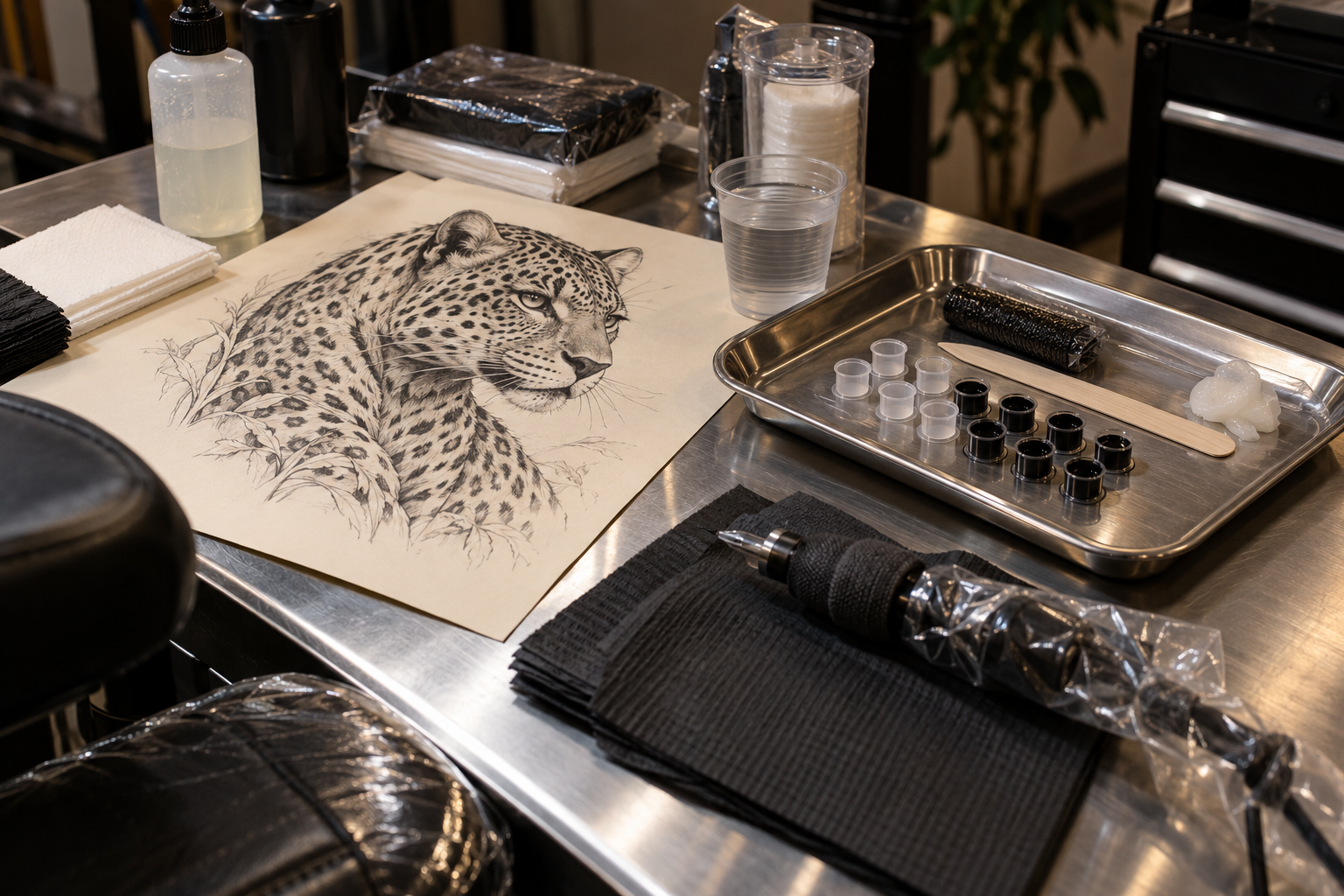
23. Abstract Leopard Spot Tattoo
Abstract spots can reference the animal without depicting it directly. A small cluster of irregular rosettes can follow the collarbone, hip, shoulder, ankle, or side of the wrist.
The key is controlled spacing. Leaving visible skin between the marks helps each shape remain distinct and gives the composition a lighter, more deliberate appearance.
24. Leopard With a Personal Symbol
One of the best ways to make a leopard tattoo genuinely personal is to combine it with one restrained symbol that matters specifically to you. That could be a tiny star, birth flower, date, initial, moon phase, landscape detail, or abstract mark.
The additional element should support the leopard rather than competing with it. This approach lets you begin with familiar imagery while creating a tattoo whose complete meaning is specific to your story.
How to Choose the Right Leopard Tattoo Placement
Placement affects more than visibility. It determines how much detail your artist can comfortably include and how the animal’s shape interacts with your body.
- Forearm: Excellent for vertical portraits, walking leopards, and fine-line designs.
- Upper arm: Offers more room for medium-sized portraits and botanical combinations.
- Shoulder: Useful for curved compositions and leopard faces.
- Ribcage: Suits long, elegant walking or climbing designs.
- Thigh: Provides generous space for realism and complex compositions.
- Ankle: Best for tiny silhouettes and simplified designs.
- Back: Gives larger concepts room for foliage, scenery, or ornamental framing.
Consider how often you want the tattoo visible, whether your design depends on small details, and whether you may want to expand it later. A design that looks excellent at eight inches may need substantial simplification if reduced to three inches.
Why Leopard Spots Need Enough Breathing Room
One of the easiest mistakes to make with a small leopard tattoo design is trying to include too many spots. Leopard rosettes are visually distinctive, but dense clusters of tiny dark shapes can make a small composition feel crowded.
Instead, identify which markings are necessary to communicate the animal. Larger, deliberately spaced rosettes can often suggest leopard patterning more successfully than dozens of miniature marks.
This is particularly important for tiny tattoos. Skin is not paper, and a tattoo should be designed for the body rather than treated as a miniature printed illustration. Ask your artist how the proposed line spacing and black areas work at the final size.
How to Plan Your First Leopard Tattoo
- Start with meaning. Decide whether your leopard represents independence, strength, resilience, intuition, adaptability, or another personal idea.
- Choose the pose. A calm portrait communicates something different from a stalking, walking, resting, or roaring leopard.
- Select your style. Compare fine-line, realism, blackwork, illustrative, ornamental, and minimalist approaches.
- Choose the placement. Match the shape of the design to the anatomy instead of forcing a favorite sketch onto an unsuitable area.
- Decide the scale. Give detailed faces and rosettes enough room to remain readable.
- Find the right artist. Look for healed examples of the specific tattoo style you want, not simply an attractive social media portfolio.
- Request an original composition. Use inspiration to communicate preferences while allowing your artist to adapt the design to your anatomy.
Fine-Line vs. Realistic Leopard Tattoos
Fine-line and realistic leopard tattoos can express the same animal in completely different ways. Neither approach is automatically better; the choice depends on how much visual weight, detail, and contrast you want.
Fine-line leopard tattoos tend to feel lighter and more understated. They work well for silhouettes, simplified faces, botanical combinations, and smaller placements. The artist may use only selected spots rather than rendering the entire coat.
Realistic leopard tattoos emphasize the eyes, fur, rosettes, anatomy, and dimensional shading. They generally benefit from more space and can become commanding statement pieces on the thigh, upper arm, shoulder, or back.
If you like both styles, a hybrid design can be an excellent compromise. A detailed face transitioning into loose linework, for example, provides a strong focal point without making the entire tattoo visually heavy.
How to Make a Leopard Tattoo Feel More Personal
The difference between an attractive animal tattoo and a meaningful one often comes down to intention. Before your appointment, write down why you chose a leopard rather than another big cat. You may discover that a particular pose, expression, or secondary element communicates that reason better than the first reference image you saved.
A leopard representing independence might work beautifully as a solitary walking silhouette. One representing patience could be shown resting on a branch. A design about resilience might combine the animal with a plant associated with renewal or personal history.
You can also personalize the artwork through composition instead of adding obvious symbols. The direction the animal faces, the posture, amount of negative space, placement, and scale can all affect the emotional character of the finished tattoo.
Questions to Ask Before Booking Your Tattoo
Once you have narrowed down your favorite leopard tattoo ideas, discuss the practical details with your artist. A good consultation should help translate the concept into artwork that suits your body and the chosen scale.
- Is my preferred size large enough for the amount of detail I want?
- Which elements should be simplified to keep the design readable?
- Would the leopard look better facing the opposite direction on this placement?
- How will the design move with the body?
- Should the spots be lighter, larger, or more widely spaced?
- Does this placement leave room if I want to expand the tattoo later?
- Can I see healed examples of similar linework, shading, or animal tattoos?
Bring reference images for mood, placement, pose, and style, but avoid expecting an exact copy of someone else’s tattoo. An original composition designed around your anatomy will usually feel much more intentional.
Choosing a Leopard Tattoo That Still Feels Like You
Leopard imagery can be fierce without being aggressive, elegant without being delicate, and symbolic without requiring an obvious explanation. That versatility is what makes it such a strong tattoo subject.
If you want maximum impact, consider a realistic portrait, an open-mouth leopard, or a larger thigh or shoulder composition. If you prefer something quieter, explore a fine-line face, tiny walking silhouette, leopard eyes, paw print, or abstract rosettes. Botanical, lunar, ornamental, and geometric details can personalize the idea further.
Most importantly, do not judge a design only by how impressive it looks in a reference photo. Consider whether its meaning, scale, style, and placement make sense for you. The strongest leopard tattoo is not necessarily the one with the most spots or the most detail. It is the one that turns the leopard’s unmistakable character into a piece that feels intentional, balanced, and personally significant.