How to Choose the Best Forearm Tattoo Placement
The forearm is one of the most versatile places to get tattooed. It gives you enough room for detailed artwork, works beautifully with small minimalist designs, and can accommodate everything from a single fine-line motif to a piece that wraps around the arm. The harder decision is often not what to tattoo, but exactly where to put it.
This forearm tattoo placement guide compares the inner forearm, outer forearm, side placements, wrist area, elbow-side positions, and wrap-around designs so you can choose a location that works with your tattoo rather than against it.
The best placement depends on several factors: how visible you want the tattoo to be, the shape and orientation of the design, your tolerance for discomfort, your lifestyle, and whether you may eventually add more tattoos around it.
There is no universally perfect spot. A placement that looks incredible for a long botanical design may not be ideal for a compact symbol. Likewise, someone who wants to see their tattoo throughout the day may prefer the inner forearm, while someone building a sleeve might prioritize how the piece connects to the outer arm.
Before your appointment, think about the tattoo as part of the three-dimensional shape of your arm rather than as an image being placed on a flat sheet of paper. That simple shift in perspective can make a major difference.
Inner Forearm Tattoo Placement
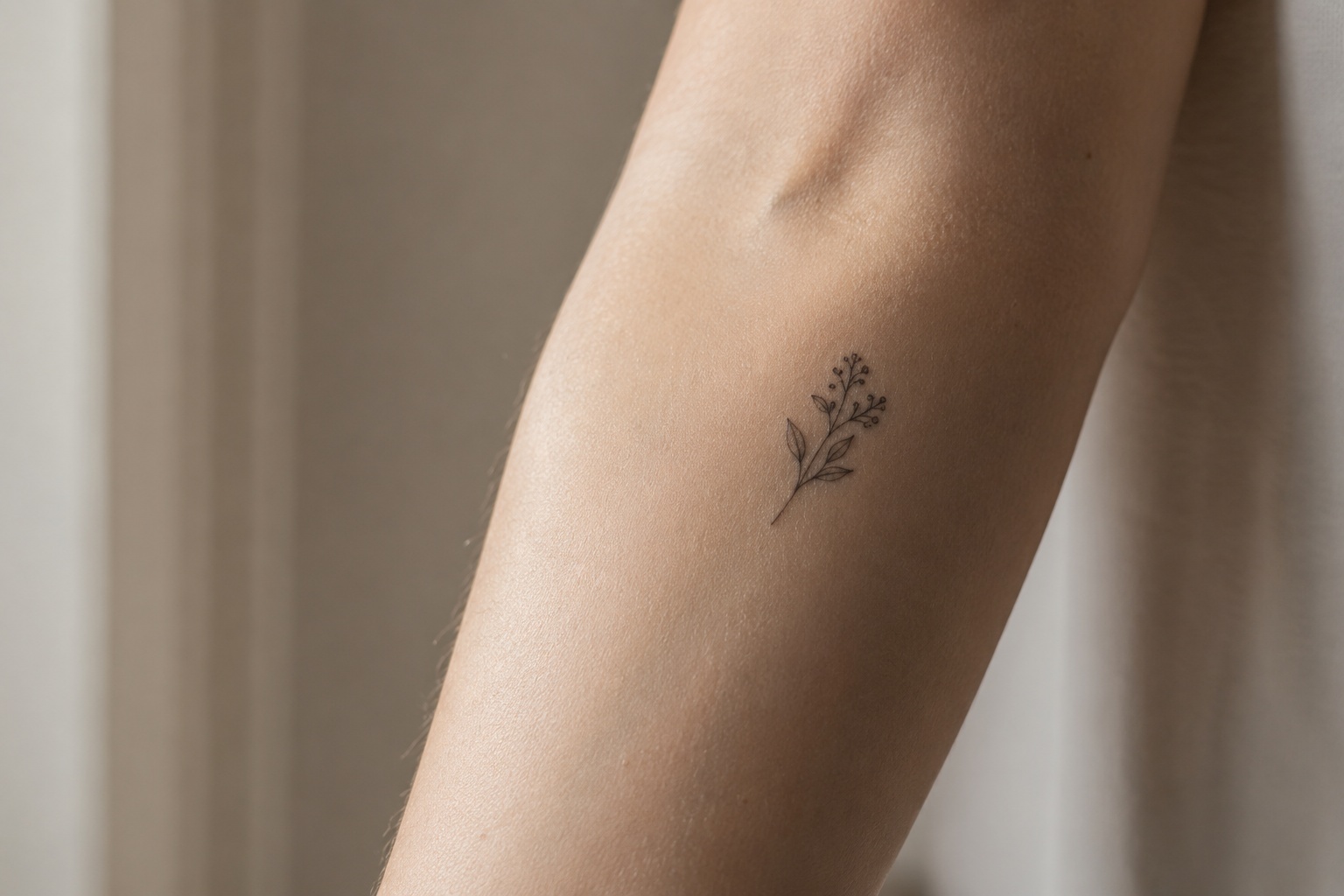
The inner forearm is one of the most popular locations for fine-line, meaningful, and minimalist tattoos. When you turn your palm upward, this is the relatively flat area running between the wrist and elbow crease.
An inner forearm tattoo tends to feel personal because it can face you naturally. It is also easy to photograph and offers a relatively clean visual canvas for designs that depend on delicate linework.
Why Choose the Inner Forearm?
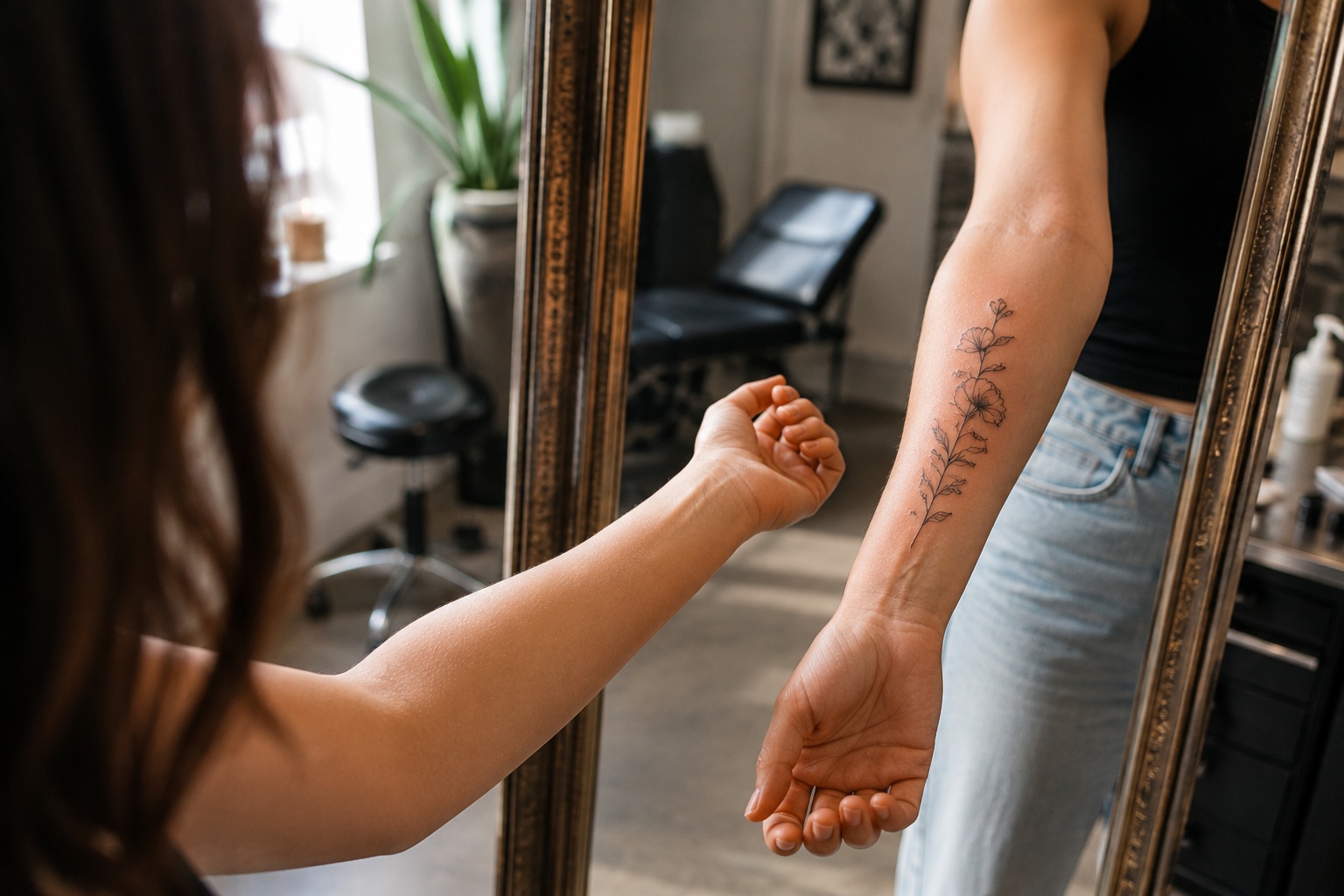
The inner forearm works particularly well for narrow vertical compositions. Botanical stems, lettering, celestial designs, ornamental pieces, snakes, swords, abstract lines, and elongated flowers can follow the length of the arm naturally.
It can also provide some control over visibility. Long sleeves cover most forearm tattoos easily, while shorter sleeves leave them visible. Turning the arm inward can make a smaller inner placement somewhat less prominent in everyday situations, although it should not be considered a truly hidden placement.
Another advantage is that the center of the inner forearm is relatively flat compared with areas wrapping toward the sides. This can make symmetrical or detail-heavy designs easier to visually understand when the arm is held in a neutral position.
What to Consider Before Choosing It
Sensitivity varies significantly from person to person. Tattooing closer to the wrist, elbow crease, or areas where structures sit closer to the skin may feel more intense than working through the broader central portion of the forearm.
You should also consider orientation. If the tattoo contains a recognizable subject, decide whether you want it to read naturally to other people when your arm hangs down or primarily face you when you look at it. Your artist can stencil both orientations before you commit.
Outer Forearm Tattoo Placement
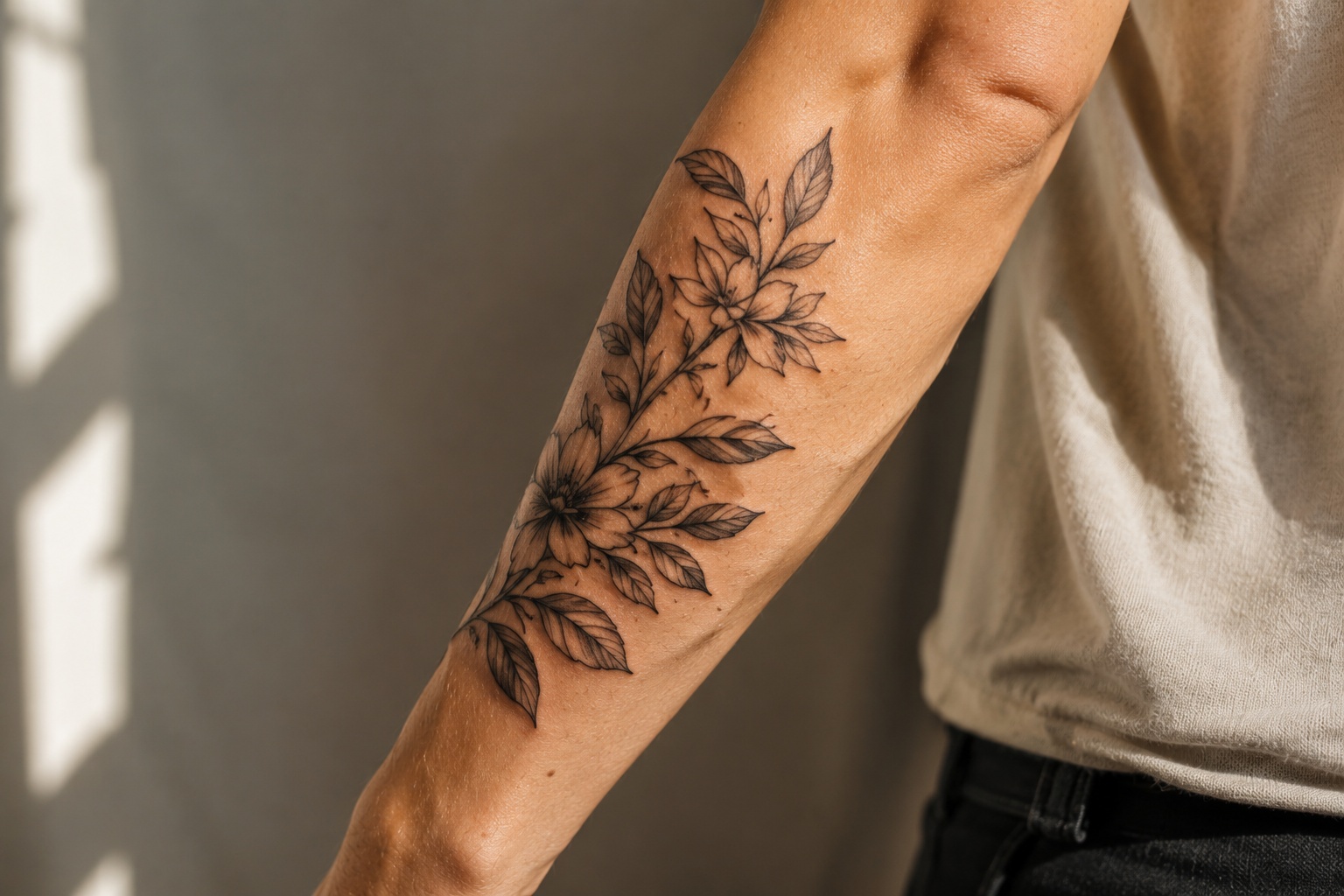
The outer forearm offers a different visual effect. Tattoos here tend to be more immediately visible when your arms are resting naturally at your sides, which makes this area particularly effective for artwork intended to have a stronger visual presence.
Outer forearm tattoo placement works especially well for illustrative designs, bold botanical work, animals, ornamental motifs, geometric compositions, larger fine-line pieces, and tattoos intended to become part of a sleeve.
Why the Outer Forearm Works for Larger Designs
The outer surface gives an artist substantial usable space between the elbow and wrist. A medium or larger design can follow the arm vertically without needing to wrap excessively around the sides.
This area is also useful when planning future work. If you think you may eventually create a half sleeve or full sleeve, an outer forearm piece can act as a visual anchor. Smaller complementary elements can later be added around it to build a cohesive composition.
Visibility is the tradeoff. An outer forearm tattoo is difficult to overlook when you wear short sleeves. If workplace requirements or personal preferences make easy concealment important, consider how often you are comfortable wearing long sleeves.
Sun Exposure Matters
Forearm tattoos are exposed areas, and the outer forearm can receive considerable sunlight during normal daily activities. UV exposure can contribute to tattoo fading over time, so healed tattoos benefit from sensible sun protection.
The inner forearm is not automatically immune to fading either. Placement, individual skin, friction, aftercare, ink application, design density, and cumulative sun exposure can all affect how a tattoo ages. Rather than assuming one side will always age better, plan for long-term care based on your actual lifestyle.
Wrap-Around Forearm Tattoo Placement
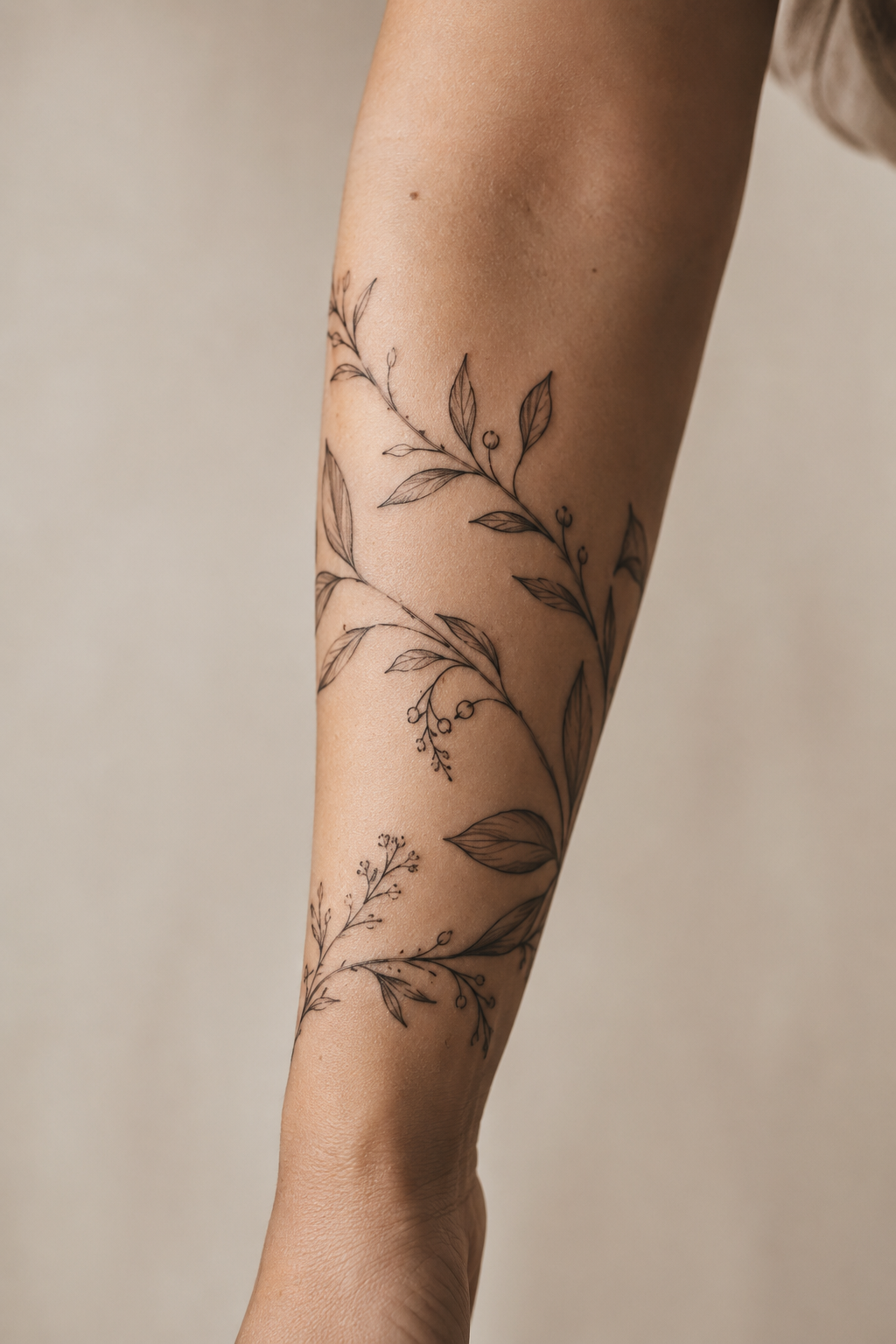
A wrap around forearm tattoo uses the cylindrical shape of the arm as part of the composition. Instead of treating the forearm like a flat canvas, the design travels around its circumference.
This placement can create beautiful movement. Vines can spiral upward, snakes can curve around the arm, ornamental lines can form bracelet-like bands, and botanical elements can appear to grow naturally around the forearm.
Design Flow Is Especially Important
A wrap-around tattoo cannot be judged properly from only one angle. Parts of the artwork disappear from view as the arm rotates, so the artist needs to consider how the tattoo looks from the front, side, and back.
The strongest wrap-around designs usually have intentional visual anchors. One major flower, symbol, leaf cluster, or other focal element can occupy a prominent surface while secondary lines travel around the arm.
This prevents the tattoo from looking like a flat image that was simply stretched around the body.
Full Wrap Versus Partial Wrap
You do not need a complete 360-degree design to achieve movement. A partial wrap can begin on the inner forearm, travel around one side, and finish on the outer surface.
This approach works especially well for fine-line botanical tattoos because stems and leaves naturally lend themselves to curved compositions. It can also leave more negative space, giving individual details room to remain visually distinct.
A complete band or continuous wrap creates a stronger statement. Because alignment becomes especially noticeable in designs with straight borders, geometric patterns, or repeating elements, careful stencil positioning is essential.
Forearm Tattoo Pain: Inner vs. Outer vs. Wrist
Tattoo pain is subjective, so no placement guide can tell you exactly how a session will feel. Individual sensitivity, session length, tattooing technique, design complexity, stress, fatigue, and proximity to sensitive anatomy all influence the experience.
For many people, the broad fleshy sections of the forearm are relatively manageable compared with more sensitive tattoo locations. Areas approaching the wrist and elbow can feel sharper or more intense.
- Central inner forearm: Often considered manageable, although individual sensitivity varies.
- Central outer forearm: Commonly chosen for medium and larger tattoos and often considered approachable for a first piece.
- Near the wrist: Can feel more sensitive as the tattoo approaches thinner or more delicate areas.
- Near the elbow crease: Frequently more sensitive than the middle forearm.
- Wrap-around placement: Sensation can change throughout the session as the artist moves across different surfaces of the arm.
If discomfort is a major concern, tell your tattoo artist before the session. Placement can sometimes be adjusted slightly without compromising the overall concept.
20 Forearm Tattoo Placement Examples
Seeing how different designs interact with the forearm makes placement decisions easier. These 20 examples show how size, direction, negative space, and visibility can influence the final result.
1. Centered Inner Forearm Botanical
A slender flower or leafy stem can run vertically through the center of the inner forearm. This placement emphasizes length and gives fine details plenty of open skin around them.
2. Small Tattoo Below the Elbow Crease
A small symbol placed a comfortable distance below the elbow crease creates a subtle upper-forearm focal point. It can work well for a tiny flower, star, meaningful symbol, or minimalist illustration.
3. Fine-Line Design Above the Wrist
A small design positioned above the wrist feels delicate without functioning as a full wrist tattoo. Leaving deliberate breathing room between the design and wrist crease usually creates a cleaner composition.
4. Long Inner Forearm Script
A short phrase or word can follow the length of the inner forearm. Lettering needs enough scale and spacing to remain legible, so avoid shrinking detailed script purely to make it feel more subtle.
5. Outer Forearm Floral Piece
A medium flower or botanical composition can use the broader outer surface as its main canvas. This creates greater visual impact than a tiny isolated motif.
6. Outer Forearm Animal Tattoo
Butterflies, birds, moths, cats, snakes, and other illustrative subjects often work well on the outer forearm because the larger visible surface gives recognizable silhouettes room to breathe.
7. Side Forearm Fine-Line Tattoo
The narrow side of the forearm is ideal for elongated minimalist work. A tiny branch, delicate ornamental line, small sword, coordinates, or understated script can follow this natural boundary.
8. Inner-to-Side Botanical Wrap
Begin a botanical motif on the inner forearm and allow its stem to curve toward the side. This introduces movement without committing to a full 360-degree wrap.
9. Outer-to-Inner Floral Wrap
Place the main flower on the outer forearm and let leaves or secondary stems travel inward. The main artwork remains visible while the smaller details reveal themselves as the arm turns.
10. Fine-Line Snake Wrap
A snake naturally suits the forearm’s cylindrical anatomy. Its body can curve around the arm while the head or another focal point remains on the preferred viewing surface.
11. Minimalist Bracelet Tattoo
A narrow line or ornamental band can circle the lower forearm. Precise positioning matters because uneven alignment is easier to notice when the design is intended to look continuous.
12. Botanical Cuff
Instead of a rigid band, leaves and flowers can create an organic cuff. Slight variations in height can make the composition feel softer and more natural.
13. Celestial Forearm Trail
A moon, stars, sparkles, and tiny planetary details can travel vertically or diagonally along the inner forearm. The negative space between elements helps keep the design light.
14. Minimalist Moth on the Outer Forearm
A moth or butterfly can sit centrally on the outer forearm with its wings following the width of the arm. Adequate scale helps preserve separation between fine details.
15. Vertical Ornamental Tattoo
Symmetrical ornamental artwork can run through the center of either the inner or outer forearm. Stencil alignment is especially important because even slight rotation may be visually obvious.
16. Small Side-Wrist Transition Tattoo
A tiny design can occupy the transition between the side of the wrist and lower forearm. This placement is highly visible, so consider both the viewing angle and how the artwork interacts with wrist movement.
17. Abstract Flowing Linework
Abstract designs can follow the natural curves of the arm rather than remaining perfectly vertical. This is a strong option when you want the tattoo to feel integrated with the body.
18. Two-Part Forearm Composition
Two related motifs can sit on different surfaces of the same forearm. For example, a flower may occupy the inner arm while a small butterfly appears slightly toward the outer side.
19. Forearm Piece Designed for a Future Sleeve
If you expect to add more tattoos, use a medium anchor design rather than filling every available gap. Intentional negative space gives your artist more options when connecting future work.
20. Full Wrap-Around Botanical Forearm Tattoo
A continuous botanical piece can move from inner to outer forearm using stems, leaves, and flowers to connect the composition. This approach is particularly effective when the artwork is drawn specifically for the client’s arm rather than adapted from a flat rectangular design.
How Tattoo Size Changes the Best Placement
Size and placement should be decided together. A beautiful design can lose its impact if it is squeezed into an area that is too narrow or enlarged without considering the arm’s contours.
Small tattoos generally work well on the inner forearm, side forearm, or above the wrist. Give them intentional negative space rather than automatically centering them in a huge empty area.
Medium tattoos can use the central inner or outer forearm effectively. This size provides enough room for more developed botanical, ornamental, illustrative, and symbolic designs.
Large tattoos may occupy most of the inner or outer forearm or deliberately extend around the sides. At this scale, body flow becomes increasingly important because the tattoo will be viewed from several angles.
How to Check Your Placement Before the Tattoo Starts
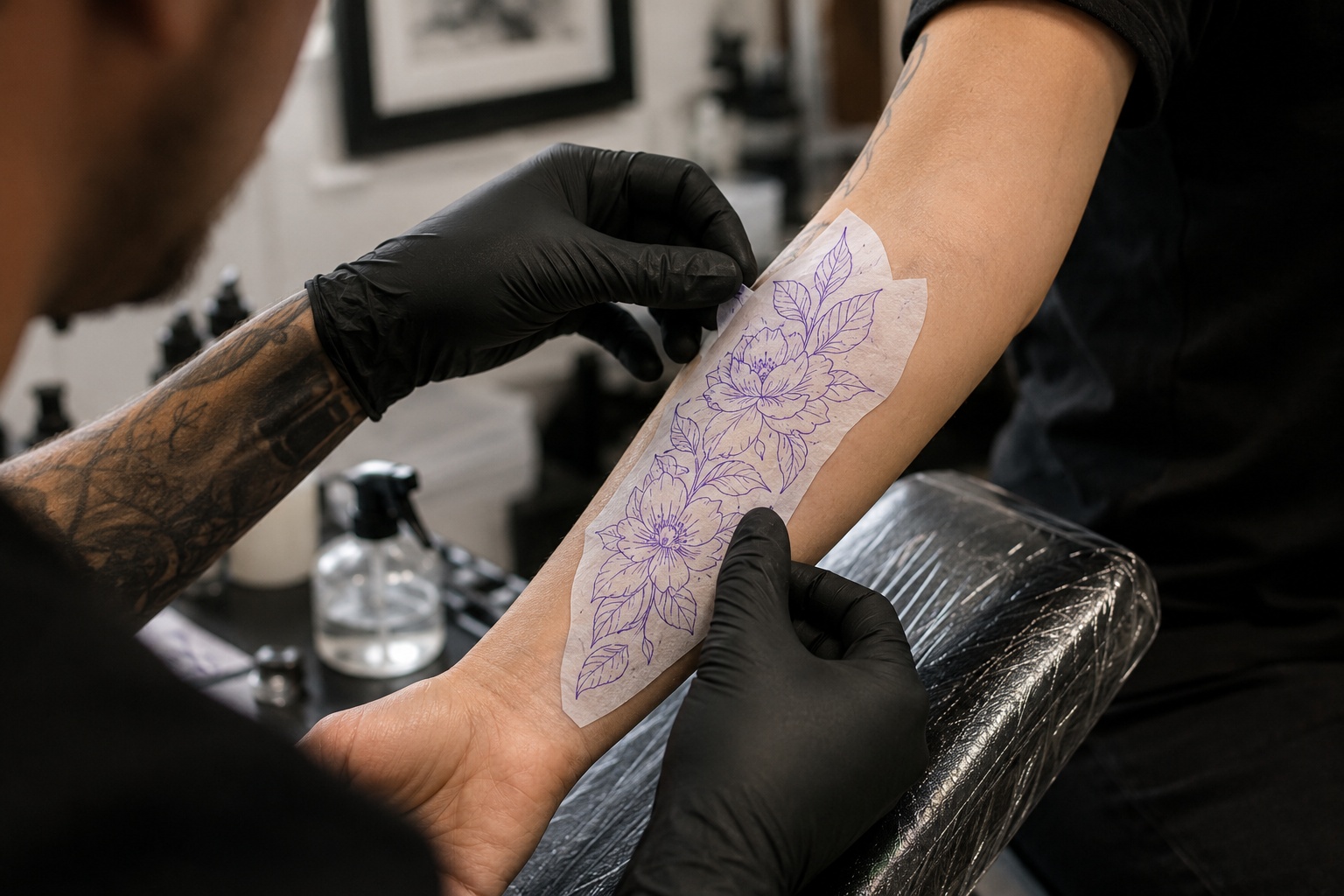
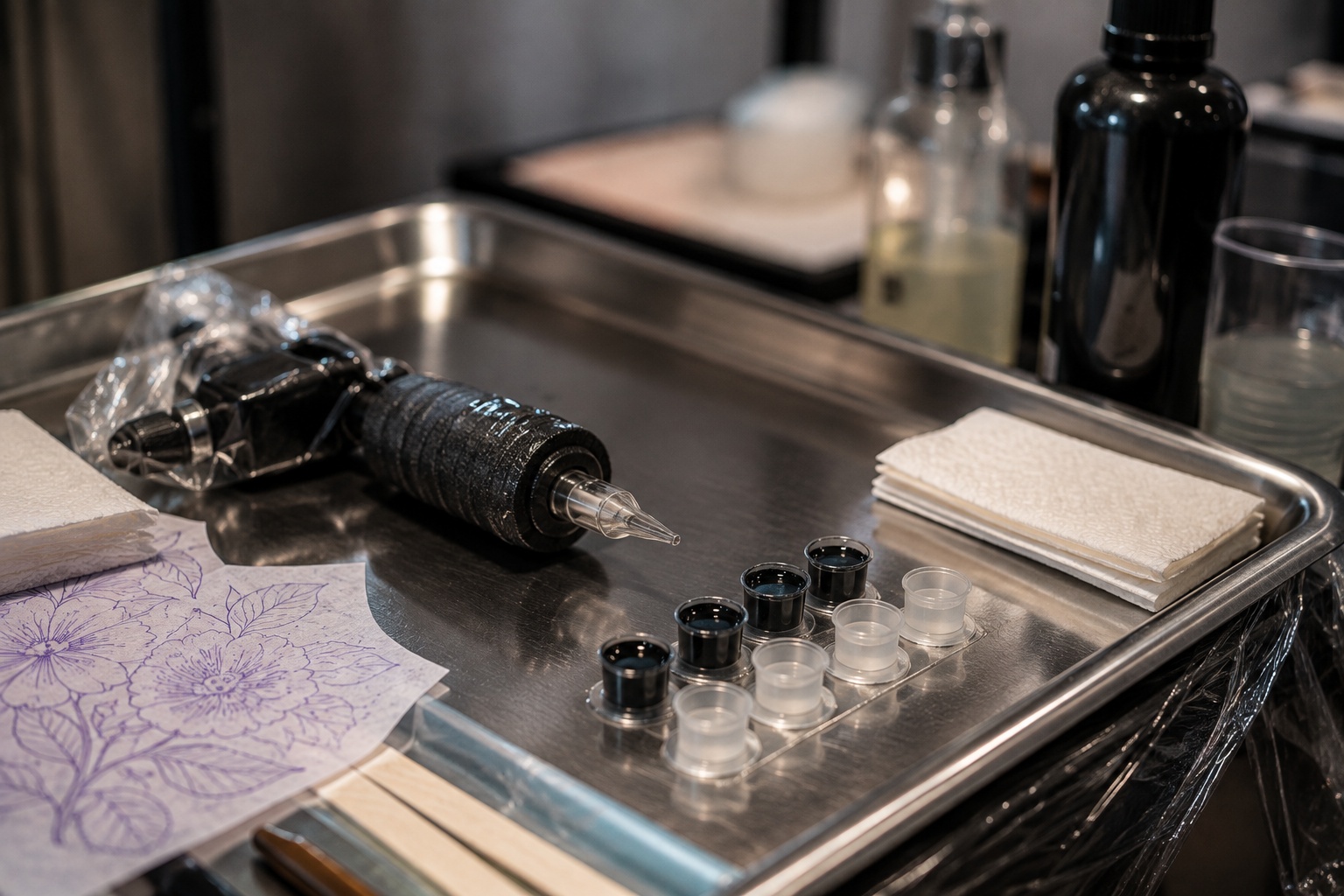
The stencil stage is one of the most useful parts of your appointment. Do not feel pressured to approve the first position simply because the stencil has already been applied.
- Look at your arm naturally. Let it hang beside your body instead of keeping it rotated into the position used during stencil application.
- Check it in a mirror. This gives you a better sense of how other people will see the tattoo.
- Rotate your wrist. Watch how the design changes as the forearm turns.
- Bend your elbow. Make sure the tattoo does not appear awkward when your arm is moving normally.
- Check the distance from existing tattoos. Consider whether the negative space looks intentional and whether you want room for future pieces.
- Take a quick photo. A photograph can make alignment or scale issues easier to notice.
- Ask for an adjustment if needed. Moving a stencil before tattooing is far easier than wishing the permanent design had been positioned differently.
Common Forearm Tattoo Placement Mistakes
One common mistake is choosing placement based entirely on a close-up inspiration photo. Pinterest and studio photographs often show the arm rotated specifically to display the artwork. Think about how that same placement looks when the arm hangs naturally.
Another mistake is making detailed artwork too small. Fine-line does not mean every element should be miniature. Adequate spacing helps the design remain readable and gives the composition a more polished appearance.
Ignoring future tattoos can also create problems. A tiny piece placed directly in the center of a large prime area may make it harder to position a bigger design later. If you think a sleeve is even a possibility, tell your artist.
Finally, avoid forcing a straight, flat composition onto a curved surface without testing it. Forearms rotate constantly. A stencil that looks centered from one viewing angle may appear different from another.
Inner or Outer Forearm: Which Should You Choose?
Choose the inner forearm when you want a placement that feels more personal, provides a relatively flat visual field, or suits fine-line botanical work, lettering, symbolic tattoos, and narrow vertical designs.
Choose the outer forearm when you want stronger everyday visibility, more visual impact, or a placement that can serve as an anchor for a larger collection or future sleeve.
Choose a wrap-around forearm tattoo when movement is central to the design. Vines, snakes, flowing ornament, branches, abstract linework, and cuffs can use the shape of the arm rather than simply sitting on top of it.
A side placement can be the best compromise if you want something slim and understated that becomes more or less visible depending on how your arm is positioned.
How to Plan a First Forearm Tattoo
If this is your first tattoo, resist the temptation to choose a position from photographs alone. Save several examples of both designs and placements, then discuss them with an experienced tattoo artist.
Think about what matters most to you: visibility, symbolism, size, design flow, future tattoos, or ease of covering the piece. Rank those priorities before your consultation.
Wear the type of clothing you normally use when evaluating visibility. A tattoo that appears easy to cover in theory may sit lower on the arm than your everyday sleeves reach.
During the stencil stage, move normally. Stand up, let your arm relax, rotate it, bend it, and view the placement from several angles. Forearm tattoos live on a moving surface, and a successful placement should make sense beyond the perfectly posed photograph.
Final Forearm Tattoo Placement Checklist
Before approving your stencil, use this quick checklist:
- Does the design look balanced when your arm hangs naturally?
- Is the tattoo facing the direction you intended?
- Is there enough space for the fine details to remain visually clear?
- Does the design follow the natural length or curve of your forearm?
- Are you comfortable with how visible the placement will be?
- Have you considered how clothing and daily sun exposure affect the area?
- Does the placement leave appropriate space for future tattoos?
- Have you looked at the stencil from the front, side, and in a mirror?
- If it wraps, does the design remain intentional as the arm rotates?
- Are you completely comfortable with the placement before tattooing begins?
Finding the Forearm Placement That Fits Your Design
The best forearm tattoo placement is the one that makes the artwork feel intentional on your body. Inner forearm tattoos offer a personal, versatile canvas. Outer forearm tattoos provide visibility and space for stronger compositions. Wrap-around designs use movement and anatomy to create something that changes as the arm turns.
Instead of deciding from a single inspiration image, compare several positions and consider how the tattoo will look while standing, walking, bending your elbow, and rotating your wrist. Size, visibility, design flow, future tattoo plans, and your own comfort all deserve consideration.
Most importantly, use the stencil as a planning tool. A good tattoo artist can adjust the scale, angle, and exact position before the first permanent line is made. Taking a few extra minutes to evaluate those details can help a beautiful design feel like it truly belongs on your forearm.